Nurse Workforce Planning With Talent Market Data: A Guide for Health Systems
—— Read time: 6 min
The short answer
Nurse workforce planning works best when it starts with the market, not the requisition. Before you post a role or commit to a new site, answer five questions: Is the talent there? What does the role pay here? Who else is hiring the same nurses? Where should we recruit, or build? And how do we brief leadership?
Talent market data answers each one in minutes. The skill is reading it honestly: an estimate isn't a verified count, and a posting isn't a hire.
Why nurse hiring plans need market data in 2027
Three numbers explain why guessing is getting expensive:
The shortage is uneven.HRSA projects a 10% national RN shortage in 2027, with non-metro areas far shorter than metro areas: 24% versus 7%. Where you recruit, and where you build, matters more than ever.
Every open day costs money. At conservative national benchmarks, one general acute RN vacancy open for 80 days puts about $112,500 of revenue at risk. See The True Cost of a Nurse Vacancy.
Market data won't make nurses appear. It tells you where they are, what it takes to hire them and when a plan is unrealistic, before you spend months finding out.
The five planning questions, answered with real market data
Each example below is a real EZ Insights run from October 20, 2026, using starting points on the Insights research menu. Employer names are blurred.
1. Is the talent there, and can we reach it?
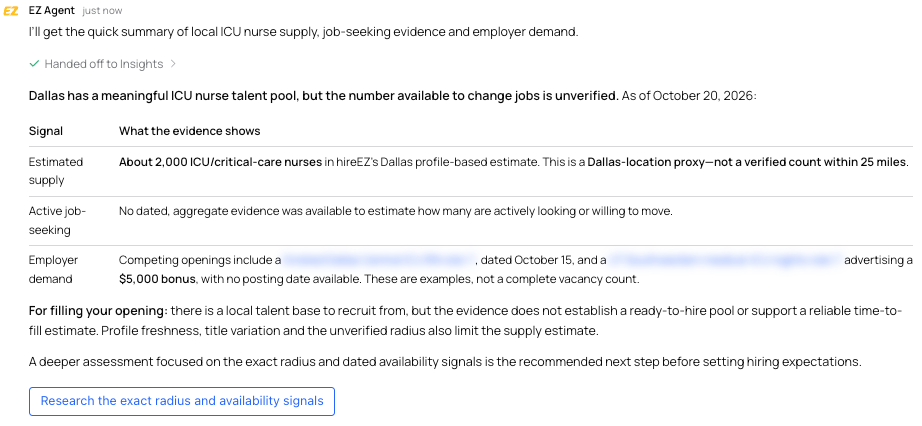
Start with availability, not job ads. We asked how available ICU nurses are within 25 miles of Dallas. Insights estimated about 2,000 ICU and critical-care nurses in hireEZ's Dallas profile data, and said plainly what it couldn't confirm: the figure is a Dallas-location proxy rather than a verified count within 25 miles, and no dated evidence showed how many are open to a move.
What to do with it: treat a market-size estimate as a ceiling, then size the pool you can actually reach. See Market Size vs. Reachable Pool.
2. What does the role pay here?
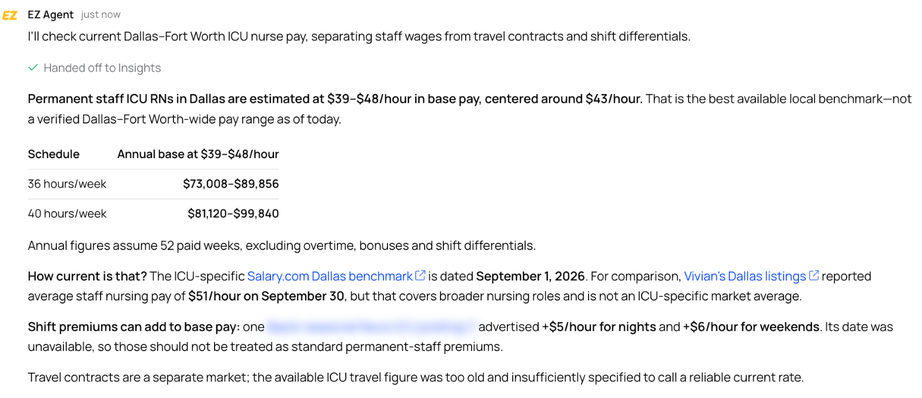
Pay decides whether your offer is competitive before a nurse ever talks to you. For permanent staff ICU RNs in Dallas, Insights estimated $39 to $48 an hour in base pay, centered around $43, or about $73,000 to $90,000 a year on 36-hour weeks. It dated its main benchmark, flagged a shift-premium example as unverified and kept travel pay separate, noting that the available travel figure was too old to call a reliable current rate.
What to do with it: compare like with like: staff base pay with staff base pay. Travel contracts are a separate market.
3. Who else is hiring the same nurses?
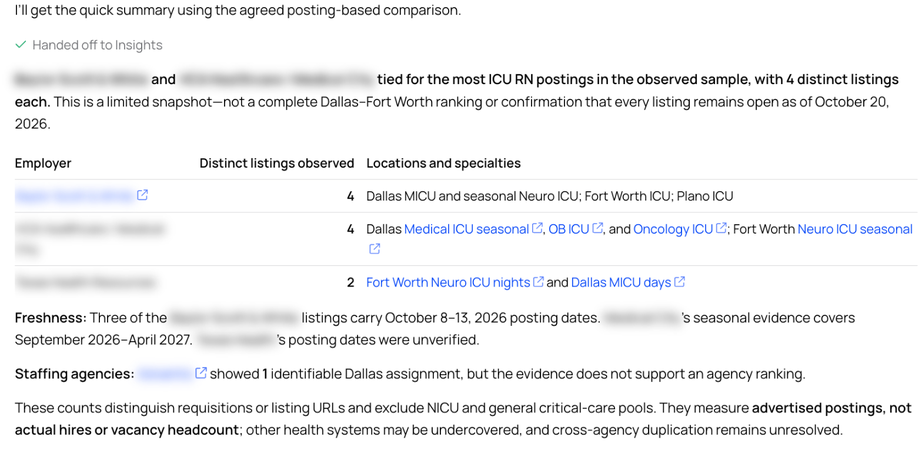
Your competition for ICU nurses is every system posting the same roles nearby. Insights compared deduplicated ICU RN postings across Dallas–Fort Worth: two health systems tied for the most, with four distinct listings each, and a third had two. It labeled the result a limited snapshot of advertised postings, not hires or vacancy headcount.
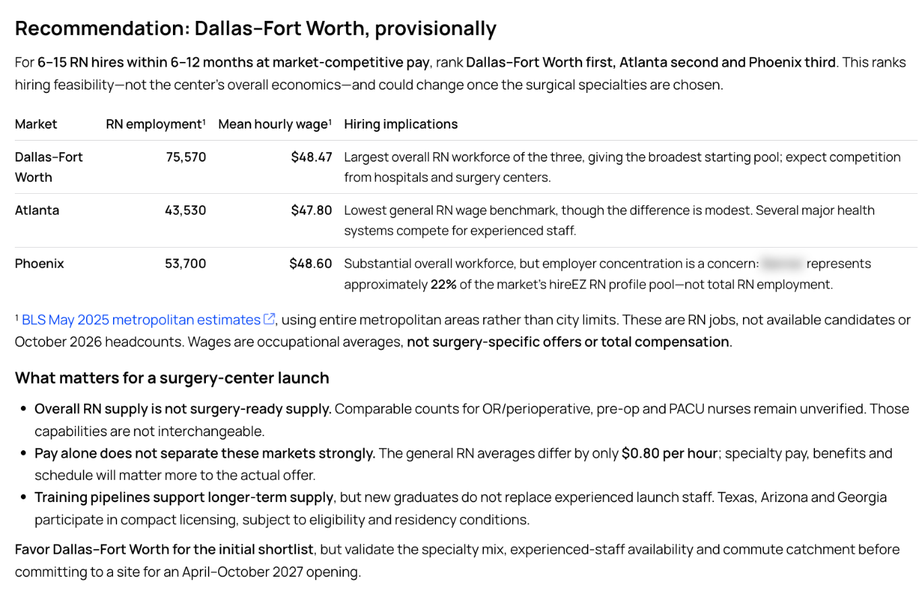
A site decision locks in your labor market for years. We asked Insights to compare Dallas, Phoenix and Atlanta for hiring 6 to 15 RNs within 6 to 12 months for a new outpatient surgery center. It ranked Dallas–Fort Worth first, Atlanta second and Phoenix third, using BLS May 2025 metro estimates: about 75,570 RN jobs in Dallas–Fort Worth, 53,700 in Phoenix and 43,530 in Atlanta, with mean RN wages within $0.80 an hour of each other. In Phoenix, it flagged employer concentration: one system holds about 22% of the hireEZ RN profile pool.
What to do with it: treat the ranking as a shortlist. Insights itself warned that general RN supply isn't surgery-ready supply: counts for OR, pre-op and PACU nurses still need checking before you commit.
5. How do we brief leadership?
Your CNO and CFO need the answer, the cost and the risk on one page. Insights offers Executive briefing as a starting point for exactly this. Pair the market picture with your cost of vacancy, and the plan covers both the talent and the money.
How to read talent market data honestly
Every example above came with caveats, and that's the point. Data that admits what it can't confirm is data finance can trust. Four rules keep a plan honest:
An estimate isn't a verified count. A profile-based estimate shows the size of a market, not how many nurses will take your call.
A posting isn't a hire. Job postings show demand, not filled roles or true vacancy headcount.
Dates matter. An old pay benchmark or an undated posting can mislead a plan you make today. Check the date behind every number.
Staff and travel are separate markets. Travel rates move differently from staff pay. Mixing them distorts both your offers and your cost of vacancy.
Make it a planning rhythm
Market data is most useful as a habit, not a one-time project. A simple rhythm:
When
Question to answer
Insights starting point
Before every hard-to-fill requisition
Is the talent there, and can we reach it?
Candidate availability, Talent mapping
Every quarter
What does the role pay, and who's competing for it?
Pay benchmark, Company intelligence, Rising employers
EZ Insights is part of hireEZ, the agentic AI recruiting platform that sits on top of your ATS. Once the market picture is clear, the same platform acts on it: it rediscovers nurses already in your ATS, searches 1B+ profiles across 45+ platforms, screens applicants around the clock and books interviews.
Bring one of your hard-to-fill units and see its market.Book a walkthrough
Frequently asked questions
What is nurse workforce planning?
It's the process of forecasting how many nurses a health system needs, where and when, and planning how to hire, develop and keep them. Strong plans start with the talent market: supply, pay and competition in each location.
What data do you need for nurse workforce planning?
Five things: how many qualified nurses are in the market and reachable, local pay for the role, which employers compete for the same nurses, how locations compare for a new site, and what each vacancy costs.
How do you choose a location based on nurse supply?
Compare the candidate markets on RN supply, pay and employer competition, then check specialty-ready supply. In a real EZ Insights comparison for an outpatient surgery center, Dallas–Fort Worth ranked first of three metros, but the analysis warned that general RN supply isn't surgery-ready supply.
How much do ICU nurses make in Dallas?
In an EZ Insights benchmark from October 20, 2026, permanent staff ICU RNs in Dallas were estimated at $39 to $48 an hour in base pay, centered around $43, or about $73,000 to $90,000 a year on 36-hour weeks.
Is talent market data accurate?
It's as good as its sources and dates. Treat profile-based estimates as market size rather than verified counts, and postings as demand rather than hires. Good tools say what they can't confirm.