The True Cost of a Nurse Vacancy: How to Calculate It and Cut It
—— Read time: 7 min
The short answer
A vacant bedside RN position costs far more than the salary you aren't paying. While the role sits open, the hospital either loses capacity it can't staff or pays a premium to cover the shifts, and often both.
At conservative national benchmarks, one general acute RN vacancy open for 80 days puts about $112,500 of revenue at risk, before any premium labor or agency fees. The fastest way to cut that cost isn't a bigger sign-on bonus. It's fewer days open.
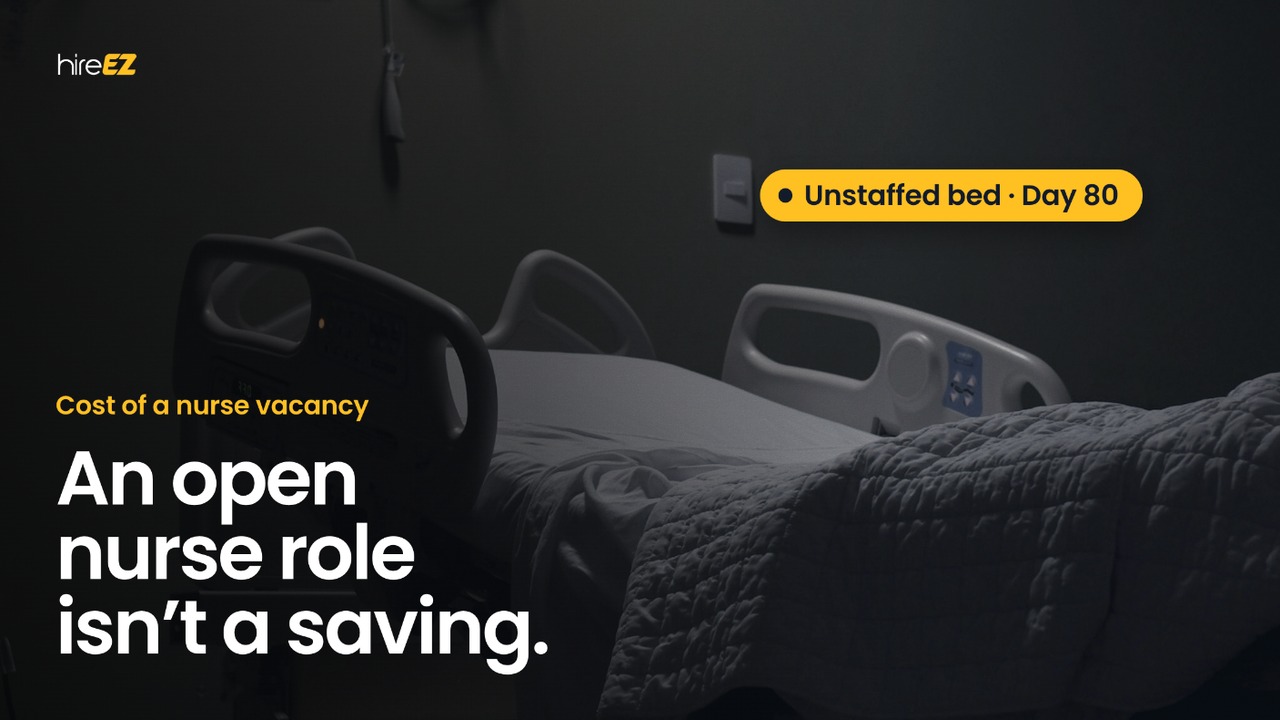
Why an open nurse role isn't a saving
On a budget report, an unfilled nurse position can look like savings: no salary, no benefits. On the unit, it works the other way.
Staffing ratios don't flex. When a bedside role is open, the unit either covers the shifts or staffs fewer beds. A bed you can't staff is revenue that goes to another facility, not revenue that waits for you.
Coverage costs a premium. Overtime, float pool and travel nurses keep beds open at a higher price. NSI's 2026 National Health Care Retention & RN Staffing Report puts travel RN pay at about $91.23 an hour all-in, against about $59.46 for an employed staff RN.
Vacancies create more vacancies. Stretched teams burn out and leave. NSI puts national RN turnover at 17.6%, costing the average hospital about $5.19 million a year.
So the real question for finance isn't what an open role saves. It's what each day open costs.
How to calculate it, in three steps
Calculate cost of vacancy role by role, not as one blended number. These three steps follow the method finance teams use to value vacant roles, and the same math as hireEZ's healthcare cost-of-vacancy calculator.
Step 1: Capacity revenue at risk
For bedside roles, an open position usually means a bed you can't staff. Value it with capacity math:
Revenue at risk = beds affected × net revenue per bed-day × occupancy × days unfilled × capture rate
The capture rate is the share of lost capacity you count after floating and overtime absorb part of the gap. It keeps the estimate honest: nothing here assumes every shift is lost.
Step 2: Hard costs
Where shifts are covered, count what the coverage costs:
Hard costs = premium per hour × covered hours + agency fees on permanent hires
Count covered shifts here and not in Step 1, so the same hours are never charged twice. At NSI's rates, the travel premium is about $32 an hour, or roughly $66,000 a year for each seat covered full time. Agency placement fees run about 22% of first-year salary.
Step 3: Subtract the payroll you didn't pay
Net cost = revenue at risk + hard costs − loaded salary for the days open
Loaded salary is base salary multiplied by 1.31 for benefits, the load factor the calculator takes from BLS employer-cost data. Because hospital labor runs about 45% to 55% of revenue, the net cost stays strongly positive.
A worked example at national benchmarks
One general acute RN vacancy, using the calculator's conservative defaults:
Input
Default
Where it comes from
Beds affected
1
One bedside position, one staffed bed
Net revenue per bed-day
$2,500
Conservative end of Medicare cost report data for large hospitals
Occupancy
75%
The calculator's default
Days unfilled
80
NSI: 2.5+ months to recruit an experienced RN
Capture rate
75%
The calculator's conservative setting
1 × $2,500 × 75% × 80 × 75% = about $112,500 of revenue at risk for this one vacancy. For an ICU role, where the default revenue per bed-day is $5,000, the same math gives about $225,000.
Across NSI's national average of 43 open RN positions per facility, the general acute figure comes to about $4.8 million. These are directional estimates at default inputs; replace each one with your own numbers.
What filling faster is worth
The cost of a vacancy is a rate: it builds every day the role stays open. So the lever that matters most is days.
Take the same general acute vacancy. If your team fills it 30% faster, 80 days becomes 56, and you save 24 days per hire. At the same conservative defaults, that protects about $33,750 of revenue per hire:
24 days × $2,500 × 75% occupancy × 75% capture = about $33,750
A 500-nurse workforce at NSI's 17.6% turnover refills about 90 roles a year. At 90 fills, that's about $3 million a year in revenue protected, before counting the premium labor and agency fees you avoid.
The 30% assumption is deliberately cautious: it sits below hireEZ's measured customer benchmark of a 50% reduction in time-to-fill. Use whatever improvement your team believes it can deliver; the math scales with it.
Where the days go, and how to cut them
The 80 days aren't one long wait. They're a chain of handoffs, and most of the delay happens between them:
Finding candidates. Job ads reach only active job seekers. Start with the nurses you already know: past applicants, former contract nurses and alumni in your ATS.
First contact. Applicants who wait for a callback take other offers. Reply to every applicant within one business day.
Screening. Phone-screen backlogs stall good candidates. Screening that runs around the clock, with recruiters reviewing every result, keeps the queue moving.
Interviews. Nurses work nights, weekends and long shifts. Offer interview times outside business hours and let candidates pick their own slot.
Offer to start. Begin credentialing and onboarding as soon as an offer is accepted, instead of waiting for each step to finish in sequence.
Time-to-fill is a recruiting metric. Revenue at risk is a business metric. When you bring vacancy cost to finance, four habits make the number hold up:
Calculate by role, not in aggregate. An ICU vacancy and a non-bedside clinical role carry very different costs. Show each one separately.
Keep the lines separate. Revenue at risk, hard costs and cost per hire are different lines. Adding them together double-counts, and hands a skeptic an easy reason to dismiss the whole number.
Show the payroll offset first. Subtract the loaded salary you didn't pay before anyone asks. It builds trust in everything else.
Use your own data. Replace benchmark defaults with your own revenue per bed-day, occupancy and time-to-fill from your ATS.
This matters more in 2027. With federal Medicaid changes taking effect that year, expect finance teams to look harder at contract labor and vacancy costs. A recruiting team that reports revenue protected per hire is no longer defending a cost center; it's running a revenue function. For the trends behind this, see What to plan for in 2027.
See it in action: from your numbers to fewer days open
1. Run your own numbers. Open hireEZ's healthcare cost-of-vacancy calculator, enter your open clinical positions, time-to-fill and revenue per bed-day, and select Show the math to see every line, including the payroll offset.
2. Cut the days. hireEZ works on top of your ATS to shorten each handoff:
Start with nurses you already know. Teams resurface 2.5x more candidates and fill 20–30% of roles from their existing database.
Reach nurses who aren't applying. Search 1B+ profiles across 45+ platforms.
Respond and screen around the clock. Voice or chat pre-screens come with a summary, a job-fit analysis and a fraud check. Customers see a 38% higher response rate and review profiles 70% faster.
Book interviews without the back-and-forth. The AI Scheduler syncs calendars and books interviews automatically.
3. Prove it. hireEZ customers see a 50% reduction in time-to-fill and a 60%+ reduction in hiring costs. Teams deploy in weeks and prove value in 90 days, and hireEZ's analytics measures your actual time-to-fill reduction from your ATS data, so the estimate becomes your number.
It's the revenue a hospital loses and the extra costs it pays while a nurse position is open: capacity it can't staff, premium labor to cover shifts and agency fees, minus the payroll it didn't pay. At conservative national benchmarks, one general acute RN vacancy open for 80 days puts about $112,500 of revenue at risk.
How do you calculate the cost of a nurse vacancy?
Multiply beds affected by net revenue per bed-day, occupancy, days unfilled and a capture rate. Add premium labor and agency fees, then subtract the loaded salary you didn't pay. Do it role by role, not as one blended number.
How long does it take to fill a nurse vacancy?
NSI's 2026 National Health Care Retention & RN Staffing Report puts the time to recruit an experienced RN at more than 2.5 months.
How much more does a travel nurse cost than a staff nurse?
NSI's 2026 report puts travel RN pay at about $91.23 an hour all-in, against about $59.46 for an employed staff RN: a premium of about $32 an hour.
Doesn't a vacancy save money, since you don't pay the salary?
In the short run it reduces payroll, but the revenue lost from capacity you can't staff, plus premium labor, usually outweighs it. Hospital labor runs about 45% to 55% of revenue, so each payroll dollar supports roughly $2 to $3 of revenue.
How can hospitals reduce the cost of nurse vacancies?
Cut the days open: start with past applicants and former contract nurses, reply to every applicant within one business day, screen around the clock and schedule interviews around shifts.