hireEZ Alternatives: What It Really Takes to Replace an Agent-Native Recruiting Platform
October 3, 2026 —— Read time: 7 min
The short answer
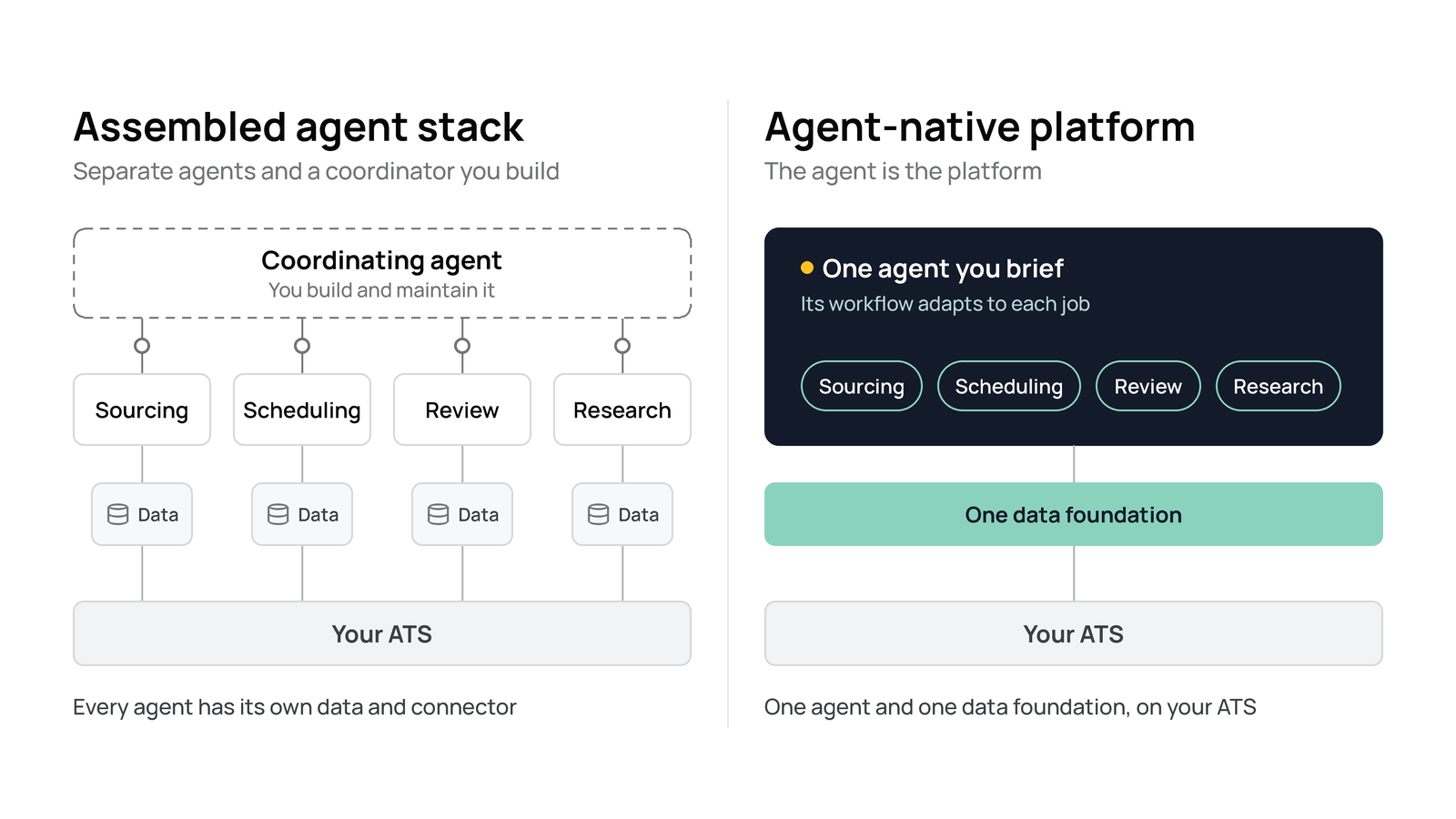
Most hireEZ alternatives fall into four categories: a single-purpose AI agent, a stack of bolt-on agents, that stack plus an agent you build to coordinate it, or a recruiting tool you build yourself.
Each can work for a narrow need. To match an agent-native platform like EZ Agent with bolt-on tools, though, you'd have to buy several agents, build the one that runs them, and own that system long after the purchase. Compare the full cost of running it, not the price of each tool.
What you'd be replacing: bolt-on agents vs. agent-native
Nearly every recruiting platform now says it has an AI agent. Most added an assistant to existing software, so it works inside one module and follows workflows set up in advance. Every recruiting platform, ours included, started there.
An agent-native platform takes a different approach: the agent is the platform. You brief it the way you'd brief a teammate, it comes back with options, and you make the calls.
Bolt-on agent
Agent-native (EZ Agent)
Where the agent lives
Inside one module or page
The agent is the platform
How you ask
Inside one module, within what that page was built to do
Say what you want in plain words; EZ Agent understands your intent through the conversation
Workflow
Set up in advance by engineers or admins
Adapts to each job and its context as work happens
Job context
Limited to what was pre-built
Intake notes, ideal-candidate profiles and documents shape how it works
The recruiter's role
Navigates pages and does each step
Briefs the agent, reviews options, makes the calls
The four kinds of hireEZ alternatives
1. A single-purpose AI agent
One agent built for one stage: sourcing, scheduling, application review or market research. Many are fast to start and easy to buy.
Good fit if: you need one stage covered and the rest of your workflow already works.
Watch for: everything before and after that stage stays in other tools, so each handoff falls to your recruiters.
2. A stack of bolt-on agents
Buy an agent for each stage: one to source, one to schedule, one to review applications, one to research the market. Some may already come bundled with tools you license.
Good fit if: each stage has a clear owner and your hiring volume is modest.
Watch for: every agent brings its own contract, login and copy of your candidate data, and none of them sees the whole req.
3. The stack, plus an agent you build to run it
Add a coordinating agent to run the stack: your team builds one with AI coding tools, or connects a general-purpose AI assistant to each agent. Either route needs every agent in the stack to offer a Model Context Protocol (MCP) connector, which adds setup, permissions and upkeep for each one. This is the closest an assembled stack gets to an agent-native platform.
Good fit if: you have an internal AI team ready to own the build and its upkeep for years, not months.
Watch for: someone has to decide which agent runs when, and that routing tends to harden into a workflow set up in advance. That's the very thing agents were supposed to remove.
4. A recruiting tool you build yourself
AI coding tools can build working, polished software quickly. In our view, though, ask one for recruiting software and you get a familiar design: pages, navigation and workflows defined in advance, with or without a chat box. That's the previous generation of software, built faster.
Good fit if: you have a narrow internal use case and engineers to maintain it.
Watch for: the build starts without a data foundation. There are no open-web candidate profiles, no enrichment of the records you already own, and no ATS integrations until you build them.
Checking the "agent" claim: Gem, Juicebox and Metaview
Every vendor in this space now uses the word "agent." These three come up most often next to hireEZ. Below is how each describes its agents in its own materials, as of the dates shown, and what to check before treating it as a replacement.
Start with four questions you can ask any vendor, including us:
Do you brief one agent in your own words, or pick a separate agent for each task?
Does the workflow adapt to each job, or follow steps set up in advance?
Can your job context, such as intake notes and ideal-candidate profiles, shape how it works?
Does it make any decisions without a recruiter's approval?
Three AI agents, one per task: sourcing, application review and fraud detection. They share one platform, one calibration and one candidate history, and work with your existing ATS or Gem's own. (Gem's AI agents page, checked October 5, 2026)
Whether you brief one agent for the whole req or work with a separate agent for each task
A candidate-sourcing platform covering search, evaluation and outreach. Each agent runs that sourcing loop for a role, using outreach sequences the recruiter approves. (Juicebox overview page, published July 17, 2026)
What happens after a candidate replies, including screening, scheduling and inbound applications, and in which tool
Agents that source, review applications, run screening conversations and turn interviews into notes, with more agents coming. Its autonomous coworker, fillmore, sources, writes outreach and books screening calls, with people in the loop where it matters. (Metaview funding announcement, September 30, 2026)
Watch the agent work on one of your live reqs. Check whether you manage one agent or several, whether it delivers on your roles, and whether you must follow a set workflow.
By their own descriptions, Gem organizes its AI as task-specific agents, and Juicebox's agents focus on sourcing. Metaview is moving toward one coworker that spans several steps, so it deserves the closest test.
Products in this category change quickly. Run all three, and EZ Agent, through the same four questions on the same live req.
What an assembled agent stack really costs
Individual agents often cost less than a platform. The stack around them is where the cost goes, so count every line below before you compare.
Cost line
What to count
Agent licenses
One per stage, plus seats as the team grows
Integration build
An MCP connector for every agent, plus each agent's link to your ATS
The coordinating agent
Building it, then updating it whenever a vendor changes its product
Security and vendor reviews
One review, contract and data agreement per vendor
Data cleanup
Duplicate and outdated candidate records spread across tools
Capacity lost to handoffs
Recruiter effort spent moving work between tools
End-to-end reporting
Building a view of what actually produced each hire
Agents are only as good as the data they run on. In an assembled stack, each agent sees its own slice of your candidate data, so none of them works from the full picture.
Then ask who owns the outcome when something breaks. With one agent per stage and a coordinator you built, a candidate who falls through the cracks belongs to no vendor. That candidate belongs to you.
When an alternative is the right call
A platform isn't always the answer. An alternative can be the better choice in three situations:
You need one stage, not the workflow. If list-building is your only gap, a single-purpose agent may be enough.
Your hiring is small and steady. A few reqs a quarter rarely justify a platform.
You have an AI team committed to owning the stack. Some enterprises want to own their coordination layer. If that's you, build it on one connected foundation rather than around a set of disconnected tools.
For teams building their own assistant layer, hireEZ MCP, in controlled release, lets approved AI assistants, including Claude and ChatGPT, work with hireEZ under each person's own permissions. You build the assistant; the data, workflow and governance underneath stay in one place.
How EZ Agent is different
EZ Agent by hireEZ is an agent-native recruiting platform. Instead of moving from page to page, recruiters brief EZ Agent in plain language. It comes back with options, and recruiters make the calls.
The agent is the platform. EZ Agent isn't an assistant added to one module.
No fixed path. Its workflow isn't set in advance; it adapts to each job as work happens.
Shaped by your job context. Intake notes, ideal-candidate profiles and documents shape how it works.
You make the calls. EZ Agent brings you options and doesn't make decisions on your behalf without your approval.
Underneath is the hireEZ system of action: 1B+ candidate profiles across 45+ platforms and integrations with 40+ ATS platforms, trusted by 70+ Fortune 500 companies. hireEZ deploys in weeks and proves value in 90 days.
Like the first mobile apps next to websites, the gap between a bolt-on agent and an agent-native platform starts small. With use, it becomes obvious.
Already a hireEZ customer? Talk to your account team before you compare.
Frequently asked questions
What are the best hireEZ alternatives?
They fall into four categories: a single-purpose AI agent, a stack of bolt-on agents, that stack plus a coordinating agent you build, or a recruiting tool you build yourself. To match an agent-native platform like EZ Agent with bolt-on tools, you'd have to assemble several agents and build the one that runs them.
Is there a cheaper alternative to hireEZ?
Individual agents can cost less on their own. Before you compare, add the integration build, the coordinating agent and its upkeep, a security review per vendor, data cleanup across tools, and the recruiter capacity lost to handoffs.
Can we build our own AI recruiting agent instead?
You can build working software quickly with AI coding tools. In our view, the result is usually page-based software with workflows defined in advance, and it starts without a candidate data foundation or ATS integrations. If you do build, build on a connected foundation rather than around disconnected tools.
Every recruiting tool says it has an AI agent. How is EZ Agent different?
Many recruiting agents were added to existing software and work inside a single module. EZ Agent is agent-native: the agent is the platform, not an assistant added to one module. You say what you want, EZ Agent understands your intent through the conversation, and it comes back with options for you to decide.
Do recruiters stay in control with EZ Agent?
Yes. EZ Agent works by delegation: you brief it, it comes back with options, and you decide. It doesn't make decisions on your behalf without your approval.