Nurse Recruitment Strategies: A 2027 Playbook for Health Systems
Last updated: —— Read time: 8 min
The short answer
Many of the nurses a health system needs are already in its ATS: past applicants, former contract nurses and alumni. The strategies that work in 2027 start there, then widen the search beyond job boards, respond to every applicant within a day and make interviews easy to schedule around shifts.
Measure the time from application to first contact and from application to start date, and you'll see exactly where nurses drop out of your process.
The nurse hiring picture: what the latest data shows
Staff RN turnover rose to 17.6% in 2025, up 1.2 points from the year before.
The national RN vacancy rate is 8.6%, and the average hospital has 43 RN positions unfilled. A third of hospitals report a vacancy rate of 10% or higher.
Losing one bedside RN costs $60,090 on average, and each one-point change in RN turnover costs or saves the average hospital about $295,000 a year.
Recruiting an experienced RN takes 78 days on NSI's recruitment difficulty index.
Turnover is highest in behavioral health, emergency, telemetry and step-down units.
Two things follow. Every week a nursing role stays open costs real money. And because so much of the gap comes from turnover, recruiting and retention have to be planned together.
What to plan for in 2027
Four developments will shape nurse hiring next year. Each one is documented; what it means for your team is our read.
The shortage is deepest where it hurts most.HRSA projects a 10% national shortage of registered nurses in 2027, with non-metro areas far shorter than metro areas: 24% versus 7%. Rural and community hospitals will need pipelines that reach well beyond the local job board.
The exit wave isn't over. In NCSBN's 2024 National Nursing Workforce Study, 39.9% of RNs and 41.3% of LPN/VNs said they intend to leave the workforce or retire within five years. NCSBN's 2026 workforce survey ran from March through September 2026, so its results will be the next read on whether exits are slowing. Plan retention and internal mobility alongside recruiting.
Budgets get tighter. Under the 2025 federal budget law, states must condition Medicaid expansion eligibility on work requirements starting January 1, 2027, according to KFF, and HFMA notes that the law's largest cuts begin in 2027. Expect finance teams to look harder at contract labor and vacancy costs.
AI hiring rules take effect.Colorado's rewritten AI law takes effect January 1, 2027, with notice and transparency requirements for automated tools that help make employment decisions. Choose AI screening with human review and clear disclosure to candidates.
Our prediction for 2027: the health systems that fill units fastest will treat their own ATS as their first talent pool, and use AI for speed while recruiters make the decisions.
Why the old playbook stalls
The familiar routine of posting the job, adding a sign-on bonus and calling the agency still fills some roles. But it leaves gaps that today's numbers make expensive:
Job ads reach only active job seekers, the same small group every hospital in the market is bidding for.
Applicants wait. Slow first contact and phone-screen backlogs lose nurses who have other offers within days.
Scheduling fights shift work. Interviews offered only in business hours miss nurses working nights, weekends or long shifts.
Past applicants go unused. Nurses who applied last year, or finished a contract with you, sit untouched in the ATS.
Contract labor becomes the default. When every hard role falls back to agency coverage, costs stay high and your own team never grows.
Nine nurse recruitment strategies that work now
1. Start with the nurses you already know
Past applicants, finalists who just missed an offer, former contract nurses and alumni open to per diem shifts are your fastest hires. Refresh their records first, so outreach reaches current contact details and reflects their latest experience.
2. Turn contract nurses into staff
Treat every contract nurse as part of your talent pool, not a one-time transaction. Start the conversation about a staff role well before the assignment ends, and ask what would make them stay.
3. Source beyond job boards
Many strong nurses aren't applying anywhere. Search professional networks, specialty communities and nursing school alumni, and filter by what the role needs: license state (including multistate licenses under the Nurse Licensure Compact), certifications such as CCRN or CEN, and unit experience.
4. Match on what predicts success on the unit
Job titles vary from one hospital to the next. Match on specialty and unit type, certifications, shift preference, commute radius and patient population, so qualified nurses aren't screened out for using a different title.
5. Respond to every applicant within one business day
Speed decides who gets the nurse. Automated voice or chat screening can run around the clock, with recruiters reviewing every result, and a fraud check before anyone reaches a nurse manager.
6. Make interviews shift-friendly
Offer interview times outside business hours, let candidates pick their own slot and coordinate nurse managers' calendars in the same step. Aim to interview within days of the application, not weeks.
7. Build pipelines before requisitions open
For units where NSI reports the highest turnover, such as behavioral health, emergency, telemetry and step-down, keep warm talent pools year-round. Time new-graduate outreach to graduation and licensure dates.
Internal transfers between units are a recruiting source in their own right, and a strong first year protects every hire you make. Exit data also shows where your nurses go, which is your real competition: see Your Talent Competitors Aren't Your Business Competitors.
What to measure
Measure
What it tells you
Where to start
Time from application to first contact
Whether nurses are left waiting
Aim for one business day
Time from application to interview
Whether scheduling is the bottleneck
Days, not weeks
Time from application to start date
Total speed, including credentialing and onboarding
Track it by unit
Share of hires from past applicants and former contract nurses
Whether you're using the talent you already have
Track it monthly
Contract labor hours and spend by unit
Where vacancies cost the most
Review it with finance every quarter
First-year RN turnover
Whether new hires stay
Track it by unit and by hire source
A 90-day plan
Days 1–30: Find the nurses you already have
Pick three hard-to-fill units.
Rediscover past applicants and former contract nurses for each unit, and refresh their records.
Start measuring time to first contact and time to start.
Days 31–60: Speed up the front of the process
Reply to every applicant within one business day, with screening that runs around the clock.
Open interview times outside business hours.
Start sourcing beyond job boards for the three units.
Days 61–90: Build what lasts
Set up year-round talent pools for high-turnover units.
Review contract labor by unit with finance, and plan contract-to-staff conversations.
Report results to leadership: speed, hires by source and contract labor trends.
See it in action: one hard-to-fill unit in hireEZ
Here's how the playbook runs for a single unit, such as ICU nurses near one of your hospitals:
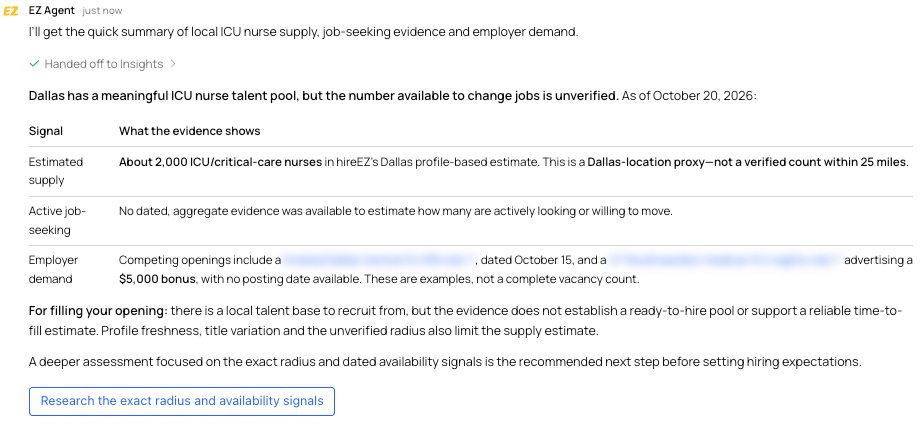
1. Size the market before you post. Ask EZ Insights how available ICU nurses are within your hiring radius. It separates the estimated pool from evidence of who's open to a move, lists competing openings and says plainly what the data can't confirm.
2. Start with nurses you already know. hireEZ refreshes and resurfaces past applicants and former contract nurses in your ATS. Teams resurface 2.5x more candidates and fill 20–30% of roles from their existing database.
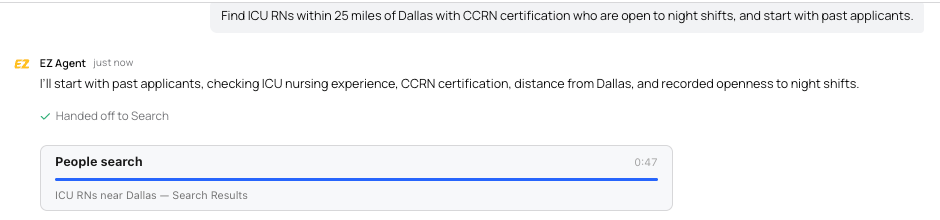
3. Brief EZ Agent for the unit. For example: "Find ICU RNs within 25 miles with CCRN certification who are open to night shifts, and start with past applicants." EZ Agent tells you its plan, checks past applicants first as you asked, and can then widen the search to 1B+ profiles on 45+ platforms and draft outreach for your review.
4. Screen and schedule around the clock. Voice or chat pre-screens run at any hour, each with a summary, a job-fit analysis and a fraud check, and scheduling coordinates nurse managers' calendars. Customers see a 38% higher response rate and review profiles 70% faster.
What are the best nurse recruitment strategies in 2027?
Start with nurses already in your ATS, convert contract nurses to staff, source beyond job boards, respond to every applicant within one business day and make interviews shift-friendly.
How long does it take to recruit a nurse?
NSI's 2026 National Health Care Retention & RN Staffing Report puts its recruitment difficulty index for an experienced RN at 78 days.
How much does nurse turnover cost a hospital?
NSI's 2026 report puts the average cost of losing one bedside RN at $60,090. Each one-point change in RN turnover costs or saves the average hospital about $295,000 a year.
How can hospitals rely less on travel nurses?
Fill more roles with your own staff: rediscover past applicants, offer contract nurses staff roles before their assignments end and keep year-round pipelines for high-turnover units.
How can AI help with nurse recruiting?
AI can resurface past applicants, search beyond job boards, screen applicants around the clock and coordinate interview scheduling, while recruiters review the results and make the decisions.
What should health systems plan for in nurse recruiting in 2027?
A projected 10% national RN shortage that's deepest outside metro areas, continued exits (39.9% of RNs told NCSBN they plan to leave or retire within five years), tighter hospital budgets as federal Medicaid changes take effect, and new AI hiring rules such as Colorado's, which takes effect January 1, 2027.