Your Talent Competitors Aren't Your Business Competitors
—— Read time: 8 min
The short answer
Your business competitors sell what you sell. Your talent competitors are the employers that hold and hire the people you need, and for many roles most of them sit outside your industry. A manufacturer hiring data engineers often competes with telecom, software and defense companies, not other manufacturers.
To find them, look at who employs the talent you're targeting, who's hiring the same profile right now, where your candidates go instead, and where your people go when they leave. Then use that list to decide where to source, how to position your offer and what to pay.
Talent competitors vs. business competitors
Business competitors
Talent competitors
Who they are
Companies that sell what you sell, to the customers you sell to
Employers that hold or hire the people you need, in any industry
What you compete for
Customers and market share
Candidates, offers and retention
How you find them
Market research and your sales team
Talent data, your ATS and your exit data
The list changes when
Your market changes
The role, the location or the labor market changes
Example: a fintech hiring data engineers
Other fintechs and banks
Telecom, software and defense employers in the same city
For industry-specific roles, the two lists can overlap. For roles every company needs, such as engineering, data, finance and sales, they rarely match. And because talent competition depends on the role and the location, there isn't one list: each critical role in each market has its own.
Five places your talent competitors show up
1. The employers that hold the talent
Where the people you want work today. This is your sourcing map: the companies to recruit from.
2. The employers hiring the same profile right now
Who's competing for the same people this quarter. Holding talent and hiring it are different signals: the first tells you where to source, the second tells you who you're bidding against.
3. Where your candidates go instead
Declined offers and withdrawn candidates, recorded in your ATS, show who won the people you wanted, and often why.
4. Where your people go when they leave
Exit data shows who recruits from your team. It's often the clearest list of all, and the one most teams never compile.
5. Where your best hires came from
Your feeder companies: the employers your strongest hires came from, and the first place to look for the next one.
The first two come from market data, and the last three from your own systems. The most useful list combines both.
A real example: who holds Denver's data engineers
In a live EZ Insights report from October 2026 on the broader pool of data engineers in the Denver area:
The largest single employer held 29% of the talent across the top ten employers.
Four of the six largest holders were telecom and media companies, alongside a customer-data software company and an aerospace and defense contractor.
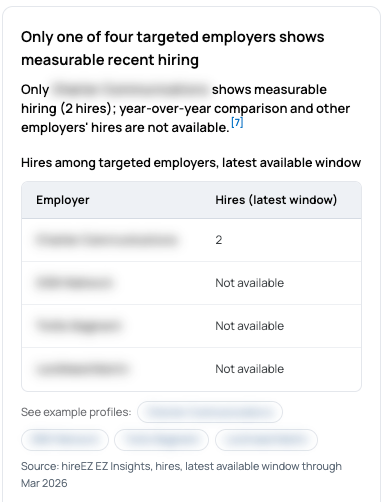
Only one of the four employers the report checked showed measurable recent hiring. For the others, hiring data wasn't available, so the report didn't treat them as idle.
So a Denver manufacturer, bank or retailer hiring data engineers isn't mainly competing with its own industry peers. Its sourcing map runs through telecom, media, software and defense, and the employers that are actively hiring the same profile show where the competition for offers is hottest right now.
We describe the employers by industry rather than by name, because the pattern is the point, not the companies.
What to do once you know them
Build target-company lists by role. Start with your feeder companies and the employers whose people match the role most closely, then widen to the rest of the employers that hold the talent.
Position your offer against them, not your industry. Know what your talent competitors offer, such as pay, flexibility, mission, stability or growth, and lead with where you're stronger.
Benchmark pay against the employers you actually compete with. An industry pay survey can miss the companies that set the price for this role in your market.
Watch their moves. Layoffs, reorganizations, hiring freezes, leadership changes and new offices all change who's open to a move, and when.
Protect your own team. If exit data shows one employer repeatedly recruiting your people, that's a retention conversation as much as a recruiting one.
Share the list. Hiring teams, compensation and employer brand make better decisions when they know who the real competition is.
Signals worth watching
Signal
What it can tell you
Where to find it
Layoffs or restructuring
People there may be more open to a move
News, company filings and layoff announcements
A hiring surge for your profile
Competition for the same people is rising
Hiring data and job postings
Long average tenure
People may be settled, so expect slower responses
Talent data on tenure
Recent job changes across the pool
The market is moving, so outreach may land
Talent data on movement
Repeated offer declines to one employer
That employer is winning your candidates
Decline reasons in your ATS
Repeated exits to one employer
That employer recruits from your team
Exit interviews and HR records
A new office opening nearby
A new local competitor for the same talent
News and company announcements
Treat each signal as a reason to look closer, not a prediction about any one person. Signals describe markets; people decide for themselves.
How to run a talent competitor review, step by step
Pick three to five critical roles, the ones that are hardest to fill or matter most to the business.
Map who holds the talent for each role, in each market you hire in.
Add who's hiring the same profile right now.
Bring in your own data: offer declines, withdrawals, exits and source of hire from your ATS and HR systems.
Compare the result with your business competitor list, and note the employers that appear only on the talent side.
Decide what changes: target lists, positioning, pay benchmarks and retention actions.
Refresh it every quarter, or sooner when a big employer in your market announces layoffs, a hiring push or a new office.
See it in action: finding Denver's talent competitors in EZ Insights
We ran this post's questions through EZ Insights in October 2026 for one market: data engineers in the Denver area.
1. Separate who holds the talent from who's hiring it. The Denver talent report ranked the employers that hold the pool, then checked which of them showed measurable recent hiring. Only one of the four did, and for the other three it said plainly that hiring data wasn't available.
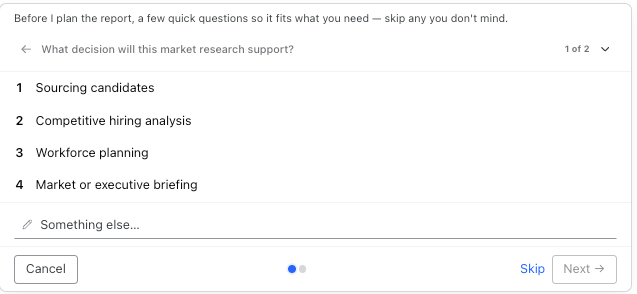
2. Ask who's pulling ahead. We asked which employers are pulling ahead in hiring Denver data engineers. Insights first asked what decision the research would support, with competitive hiring analysis as one of the options:
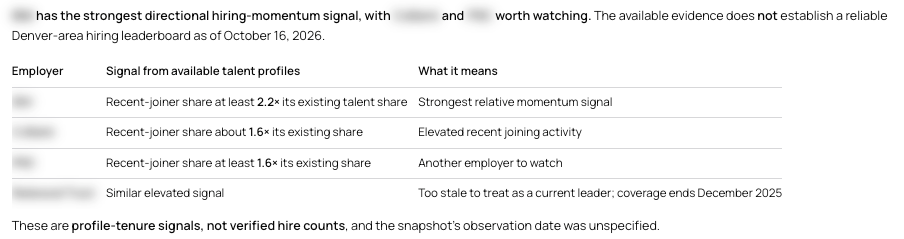
Its answer compared each employer's share of recent joiners with its existing share of the talent. A technology company led, with two banks close behind, and the answer was clear about its limits: these are profile signals, not verified hire counts, and current job postings tell a different story about demand.
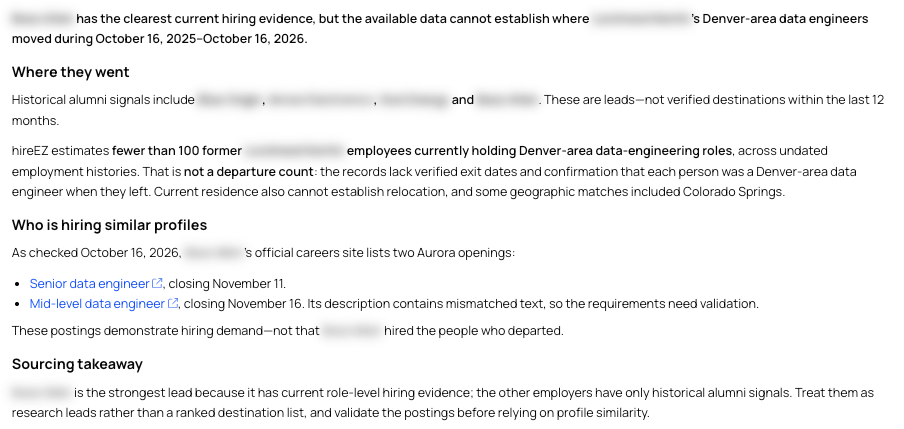
3. See where talent moves. We asked where one large aerospace and defense employer's Denver data engineers have gone, and who's hiring their profile. Its former engineers showed up at a space company, an electronics distributor, a utility and a consulting firm, which Insights flagged as leads rather than verified destinations. Only the consulting firm showed current hiring evidence for the same profile, so that's where the competition for offers is live right now.
4. Read the signals on one employer. You can also ask what a specific employer is hiring for and where it may be vulnerable, and Insights pulls together its hiring focus, news, layoffs, company filings and attrition signals, each with its source.
5. Turn it into a search. Use "See example profiles" to open real people at any employer on the list, share the report with a view-only link, then hand the target companies to EZ Agent, which sources across 1B+ profiles on 45+ platforms and your ATS, and drafts outreach for your review.
Across all three answers, the pattern held. The employers competing for Denver's data engineers were telecom and media companies, banks, technology, aerospace and defense, an electronics distributor, a utility and a consultancy. That's what a talent competitor list looks like.
Find your real talent competitors for one critical role.Book a walkthrough
Frequently asked questions
What is a talent competitor?
An employer that holds or hires the people you need, whether or not it sells what you sell.
How is a talent competitor different from a business competitor?
Business competitors compete for your customers. Talent competitors compete for your candidates and your employees. For roles every company needs, such as engineering, data and finance, the two lists rarely match.
How do you find your talent competitors?
Combine market data on who holds and hires the talent with your own data on where candidates go instead, where your people go when they leave and where your best hires came from.
What is competitive talent intelligence?
Using market data to understand which employers compete for the same talent, where that talent sits, how it moves and which signals suggest people may be open to a move.
How often should you review your talent competitors?
Every quarter for critical roles, and sooner when a major employer in your market announces layoffs, a hiring push or a new office.