How Talent Data Helps Hiring Teams Set Goals and Make Better Decisions
—— Read time: 8 min
The short answer
The best hiring goals are set together, with the same facts on the table. Bring three numbers to every intake: how many people actually match the exact role where you're hiring, who employs them and who else competes for them, and what the role really pays. Then show what each requirement costs in reachable candidates, and offer trade-offs instead of objections.
Done well, it turns intake from a list of requirements into a plan the whole team agrees on, and it makes the recruiter an advisor rather than an order-taker.
Why hiring goals drift from the market
Hiring goals usually drift for understandable reasons. Everyone involved is working from a picture of the market that's out of date or too narrow:
Teams anchor on the last great hire. The ideal candidate is often modeled on the person who just left, at the pay and seniority that person had years ago.
Requirements pile up. Each stakeholder adds one must-have, and nobody checks what the full list does to the pool.
Everyone sees their own network, not the market. Knowing ten great people makes it easy to assume there are a hundred more just like them.
Pay and location assumptions lag. Pay bands are set once a year while the market keeps moving, and on-site requirements cut the pool more than most people expect.
Generic data misleads. Broad job-category numbers rarely describe the actual role, so a big headline number can hide a small real pool.
None of this is fixed by arguing. It's fixed by looking at the actual market together.
The three numbers to bring to every intake
1. The reachable pool for the exact role
Not the total for a job category, but the people who match the role as written: the skills, the seniority and the location, within the radius you can actually hire in. Show it as a range, and say what it includes and what it leaves out.
2. Who holds this talent, and who's competing for it
Which employers hold most of the pool, and which are hiring the same profile right now. This shows the team who you're really competing against and where the strongest candidates sit. Often your talent competitors aren't your business competitors.
3. What the role really pays
A pay range for this exact role in this market, with the source of every figure. If the band is below the market, it's far better to learn that at intake than at the offer stage.
Bring a source for every number. When everyone can see where a figure came from, the conversation focuses on the trade-off, not on the data.
Show what each requirement costs
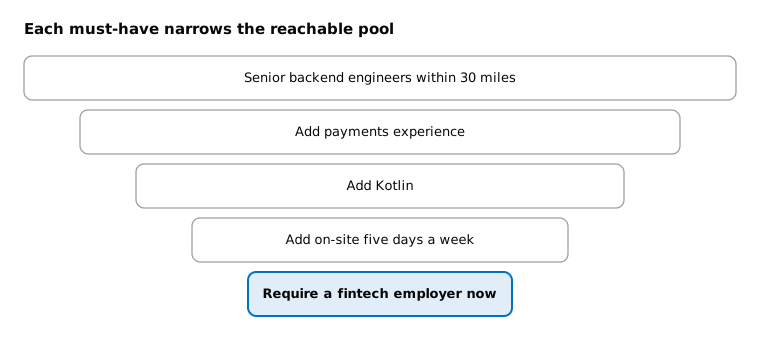
The clearest way to set a goal the team can hit is to watch the pool change as requirements stack up. Start from everyone who could plausibly do the job, then add each must-have one at a time:
Illustrative example, not real market data.
Then ask the question that changes the conversation: which of these is truly required on day one, and which could the right person learn? Each answer comes with a trade-off you can put a number on:
Relax one requirement, and show how much the pool grows.
Widen the location or allow hybrid work, and show where else the talent sits.
Adjust the pay range, and show how many more people it brings within reach.
Keep everything, and agree up front that the search will take longer and cost more.
Every option is legitimate. What matters is that the team chooses one knowing what it costs.
How to run the conversation
Send one page before the meeting. Lead with the answer: the reachable pool, the main competitors for the talent and the pay range, each with its source. A team that has read it arrives ready to decide.
Lead with shares and rankings, not exact counts. "Three employers hold most of this pool" is harder to dispute than a precise headcount, and it's the more useful fact.
Show real people. A handful of example profiles makes the numbers tangible and lets everyone react. "More like her, less like him" is the fastest calibration there is.
Bring options, not ultimatums. Offer two or three trade-offs, each with its cost, and decide together.
Write the decision into the brief. Record which requirements are must-haves, which are preferences and what you'll do if the pool stays thin. That's the brief you'll hand to your team or your AI agent; Prompts vs. Briefs shows how to write one.
Agree when you'll check back. Set a date to review the first shortlist against the market, so a slow search starts a conversation instead of frustration.
Common questions, answered with data
A question that often comes up
What the data shows
Options to decide on
"Can we find someone from a top tech company?"
Which employers hold the pool, and how many are hiring the same profile
A wider list of target companies where the same skills sit, often with less competition
"How hard will it be to find someone like our last hire?"
The reachable pool for the role as written today, at today's pay
The two requirements that shrink the pool most, and what relaxing each would add
"Is our pay range competitive?"
The pay range for this exact role and market, with sources
A higher range for a narrower profile, or the current range for a broader one
"Does this role need to be on-site every day?"
How the pool changes with on-site, hybrid and remote work, and where else the talent sits
A hybrid option, or a second location with a deeper pool
"Can we reach more candidates?"
How much of the reachable pool has already been contacted, and the response rate so far
A change in requirements, pay or location, since more effort alone won't create more people
Make it a habit
One good intake helps one search. A habit changes how the whole hiring team plans:
Bring market data to every intake, not just the hard ones. Teams learn to expect it, and to plan with it.
Refresh it when a search stalls. If the first shortlist misses, check whether the market changed or the requirements did.
Track a few calibration measures: how often the first shortlist is accepted, how many requirements change after intake, the time from intake to the first qualified slate, and offer acceptance by role and location.
Share what you learn. A quarterly one-page read on the talent markets you hire in most positions TA as the team that knows the market, not just the team that fills reqs.
See it in action: the one-page read your team gets
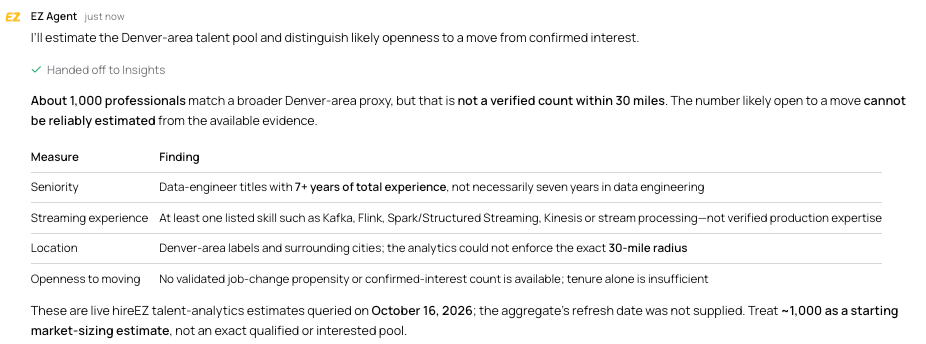
Here's what that looks like in EZ Insights, using a real request from October 2026: a talent map for senior data engineers with streaming experience near Denver.
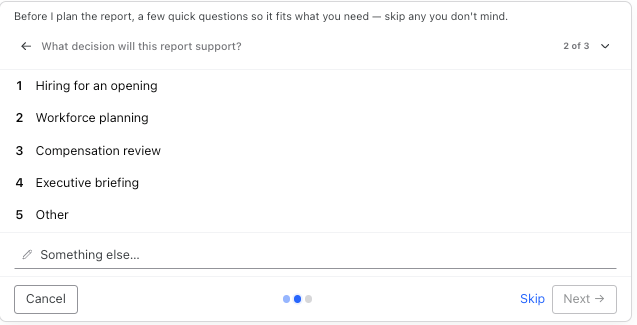
1. Start with the decision. Insights asks a few quick questions before it plans a report, and the questions adapt to each request. For this one, it first asked what decision the report would support, such as hiring for an opening, workforce planning or a compensation review. That's the question the whole team should agree on before anyone looks at a number.
2. Get the answer first. A plain question can get a quick answer right in the chat in under a minute, or you can choose a quick or a full report. Asked how many senior streaming data engineers sit within 30 miles of Denver, the quick answer led with the number, stated exactly how it defined seniority, skills, location and openness, and told the team to treat it as a starting estimate, not an exact pool.
3. Bring the sources with you. Reports cite a numbered source for every figure, so when someone asks where a number came from, the answer is on the page: hireEZ data, government labor statistics, company filings or published research.
4. Put people behind the numbers. Open real example profiles from any chart, with candidates already in your hireEZ flagged. Reacting to real people is the fastest way for a team to agree on what good looks like.
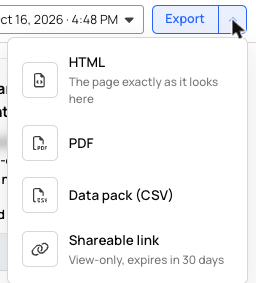
5. Share one link. Send a view-only link that needs no login and expires after 30 days, so everyone in the meeting sees the same evidence, or export the report as HTML, PDF or a CSV data pack.
Once the team agrees on the plan, EZ Agent turns it into the search, from sourcing to outreach, in the same platform. For more on sizing the pool itself, see Market Size vs. Reachable Pool, and for the full platform, see What Is hireEZ?.
Bring your hardest role and see the one-page read for it.Book a walkthrough
Frequently asked questions
How do recruiters and hiring managers agree on a hiring plan?
Bring market data to the intake: the reachable pool for the exact role, who holds and competes for that talent, and the real pay range. Then show what each requirement costs and agree on the trade-offs together.
How do you set hiring goals with data?
Start from the market. Agree on the reachable pool for the exact role, the competition for that talent and the pay range, then decide together which requirements are must-haves and what the search can realistically deliver, and by when.
What data should recruiters bring to an intake meeting?
Three numbers: the reachable pool for the role as written, the employers that hold and compete for the talent, and the pay range for this role and market, each with its source.
What do you do when a role's requirements seem impossible to meet?
Show how each requirement narrows the pool, ask which ones are truly needed on day one, and offer trade-offs such as relaxing one requirement, widening the location or adjusting pay.
How do you know whether a pay range is competitive?
Compare it with a pay range for the exact role and market, with named sources, and see how many more candidates a higher range would bring within reach.
What's the difference between a talent pool and a reachable pool?
A talent pool counts everyone in a broad category. A reachable pool counts the people who match the role as written, in the area where you can hire, and it's usually far smaller.