Market Size vs. Reachable Pool: How to Tell Whether You Can Actually Hire for a Role
—— Read time: 8 min
The short answer
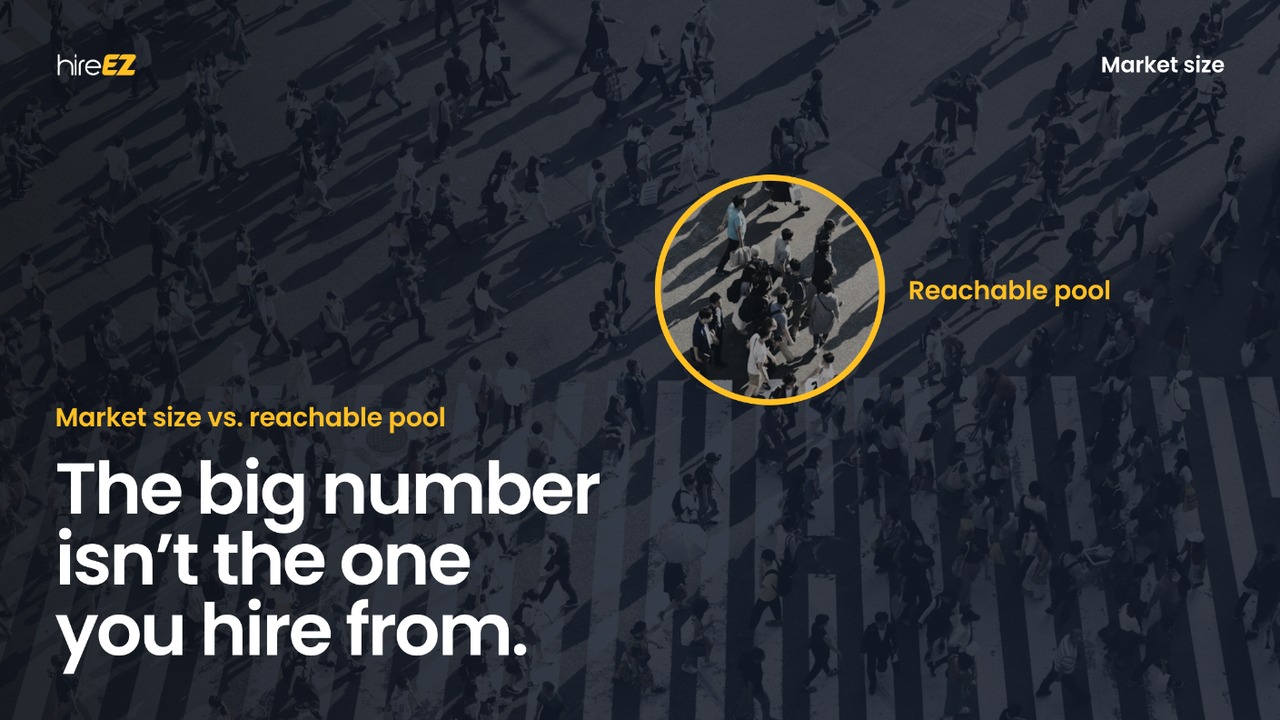
Market size counts everyone in a broad category, such as all data engineers in a metro area. The reachable pool counts the people you could actually hire for this role: those who match the role as written, live or will work where you hire, are likely open to a move, and can be reached through your channels.
The reachable pool is usually a small fraction of the market size, and it's the number to plan around. It tells the hiring team how long a search may take, which channels to use and which trade-offs to weigh before the first outreach goes out.
Two numbers, two different questions
Market size
Reachable pool
What it counts
Everyone in a broad occupation or job category in a region
People who match the role as written, where you hire, likely open to a move and reachable
The question it answers
Does this kind of talent exist here?
Can we hire for this role, here, now?
Good for
Comparing regions, long-range planning and sizing a market for a new team
Setting goals and timelines, choosing channels, and planning outreach and budget
Misleading when
It's used to set targets or timelines for one specific role
It's built on broad job codes instead of the exact role
Both numbers are useful. Trouble starts when the first one is used to answer the second one's question.
The four filters that turn market size into a reachable pool
1. Exact role fit
Start with the role as written, not the nearest job code: the skills that matter, the seniority, and any hard requirements such as a certification or a security clearance. This filter usually removes the most people, because a broad category mixes many different jobs.
2. A location you can hire in
Keep the people within the radius or time zones you can actually hire in, and account for whether the role is on-site, hybrid or remote. A metro-wide count can include people who would never commute to your site.
3. Likely open to a move
Not everyone who fits is open to a change right now. Signals such as time in role and recent movement in the market help estimate who's likely to listen. Treat this as an estimate, not a certainty.
4. Reachable through your channels
Finally, keep the people you can actually contact: those already in your ATS and those you can reach through the channels your team uses. Someone you can't contact isn't part of your pool yet.
Each filter involves judgment, so write down the assumptions behind it. The goal isn't a perfect count; it's a number the team can plan with and revisit.
A worked example
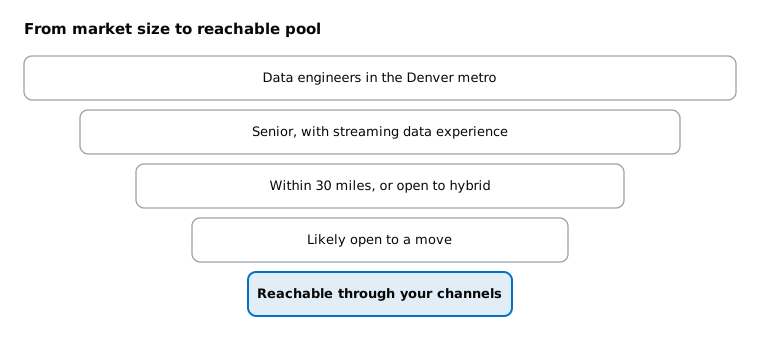
Here's how the filters play out for a senior data engineer role in Denver. Each step keeps only the people who pass the filter before it:
Illustrative example, not real market data.
The first bar is the market size, the number that often shows up in a planning deck. The last bar is the reachable pool, the number the search will actually be measured against. In real searches the gap between them is often large, which is why a team can see a big market and still struggle to fill one role.
Two practical notes:
Keep the steps visible. Showing each filter makes clear which requirement or assumption shrinks the pool most, so the team knows exactly what a trade-off would change.
Check it against real people. Look at a handful of actual profiles in the final pool. If they don't look like the hire you want, the filters need another pass.
Why big numbers mislead planning
When market size stands in for the reachable pool, the errors show up downstream:
Timelines come out too short. A big market suggests a fast search, so a slow one looks like a recruiting problem when it's really a pool problem.
Targets get set too high. Hiring plans built on market size can promise more hires per quarter than the reachable pool can support.
Budget goes to the wrong channels. Job ads and broad campaigns make sense for a large reachable pool; a small one calls for targeted outreach and rediscovery instead.
Trade-offs come too late. If the team learns the pool is thin only after weeks of searching, the changes to requirements, pay or location that could have helped start late.
Trust erodes. When results don't match the big number, recruiting and the business stop sharing the same picture of the market.
None of this makes market size wrong. It's the right number for a different question.
How hiring teams use the reachable pool
The size of the reachable pool shapes the whole plan, not just the search:
If the reachable pool is
What it usually means
What the team can plan
Large
Many people fit, and competition for them is manageable
Broad channels such as job ads and campaigns, a standard timeline, and enough screening capacity
Moderate
Enough people fit, but each one counts
Targeted outreach plus rediscovery in your ATS, personalized messages, and a timeline agreed up front
Small
Few people fit, and many are hard to reach
Revisit requirements, location or pay first; work your ATS and referrals; and plan a longer or phased search
What counts as large or small depends on the role and your own response rates. Define the thresholds from your history: how many people you typically contact to make one hire for this kind of role.
How to estimate a reachable pool, step by step
Start from the market. Get the broad count for the occupation and region, so you know the ceiling.
Define the role precisely. Agree on the must-haves with the hiring manager, and keep preferences separate.
Set the geography. Choose the radius or time zones, and whether the role is on-site, hybrid or remote.
Estimate openness. Use signals such as time in role and recent moves to estimate who's likely to listen.
Check your reach. Count who's already in your ATS and who you can contact through your channels.
Look at real people. Review a sample of actual profiles in the pool before you share the number.
Write down your assumptions, and revisit them when the market or the role changes.
See it in action: this post's example in EZ Insights
The Denver funnel above is illustrative, so we ran the same role through EZ Insights in October 2026: senior data engineers with streaming experience within 30 miles of Denver.
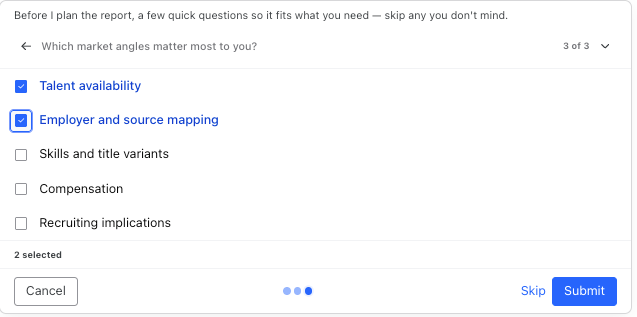
1. Ask in plain language. We asked for a talent map of the role. Insights asked a few quick questions first, and the questions adapt to each request. Here it asked what decision the report would support and which market angles mattered most:
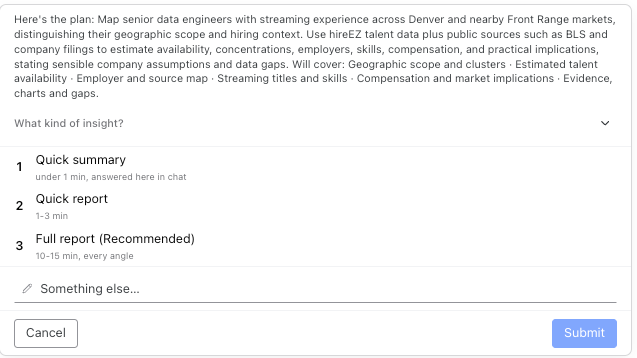
Then it laid out its plan, including the geographic scope, estimated talent availability and an employer and source map, and offered a quick summary, a quick report or a full report before running anything:
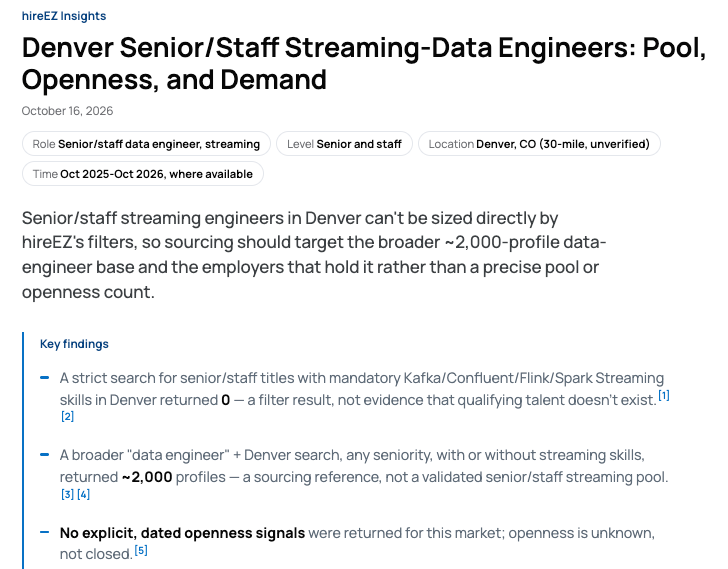
2. Read the answer first. A Quick report on the same role opened with this post's lesson. A strict search for senior and staff titles with required Kafka, Confluent, Flink or Spark Streaming skills returned 0, which the report called a filter result, not evidence that the talent doesn't exist. A broader search for data engineers in Denver returned about 2,000 profiles: a starting point for sourcing, not a validated pool. And with no dated signals of openness to a move, it called openness unknown, not closed.
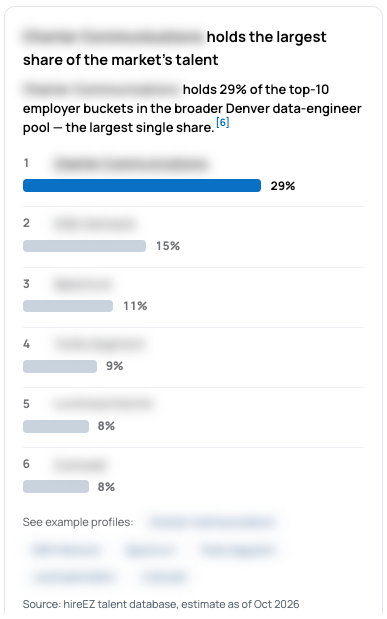
3. See where the pool sits and who holds it. The largest single employer held 29% of the talent across the top ten employers, and only one of the four employers the report checked showed measurable recent hiring. Every figure carries a numbered source.
4. Check the pool against real people. Use "See example profiles" under any chart to open real profiles, with candidates already in your hireEZ flagged. It's the quickest way to see whether the pool looks like the hire you want.
5. Share it, then act on it. Send a view-only link that needs no login and expires after 30 days, or export the report as HTML, PDF or a CSV data pack. Once the team agrees on the role, EZ Agent sources against it across 1B+ profiles on 45+ platforms and your ATS, and drafts outreach for your review.
The report didn't invent a precise count where the data couldn't support one. It said what it could size, what it couldn't, and where to look instead, which is exactly the difference between market size and a reachable pool. To bring these numbers into the intake meeting, see How Talent Data Helps Hiring Teams Set Goals and Make Better Decisions, and for the full platform, see What Is hireEZ?.
What's the difference between market size and a reachable pool?
Market size counts everyone in a broad category in a region. A reachable pool counts the people who match the role as written, where you can hire, who are likely open to a move and whom you can contact.
What is an addressable talent pool?
Another name for the reachable pool: the part of the market you could realistically recruit for one specific role.
How do you calculate a reachable talent pool?
Start from the market count, then apply four filters: exact role fit, a location you can hire in, likely openness to a move and reach through your channels. Check the result against real profiles.
Why is my talent pool smaller than market data suggests?
Market data usually counts a broad job category. Once you apply the role's actual skills, seniority, location and reachability, most of that number falls away.
How big does a reachable pool need to be to fill a role?
It depends on your response and conversion rates. Work backward from your own history: how many people you typically contact to make one hire for this kind of role.