Prompts vs. Briefs: How to Work With an AI Recruiting Agent
October 10, 2026 —— Read time: 7 min
The short answer
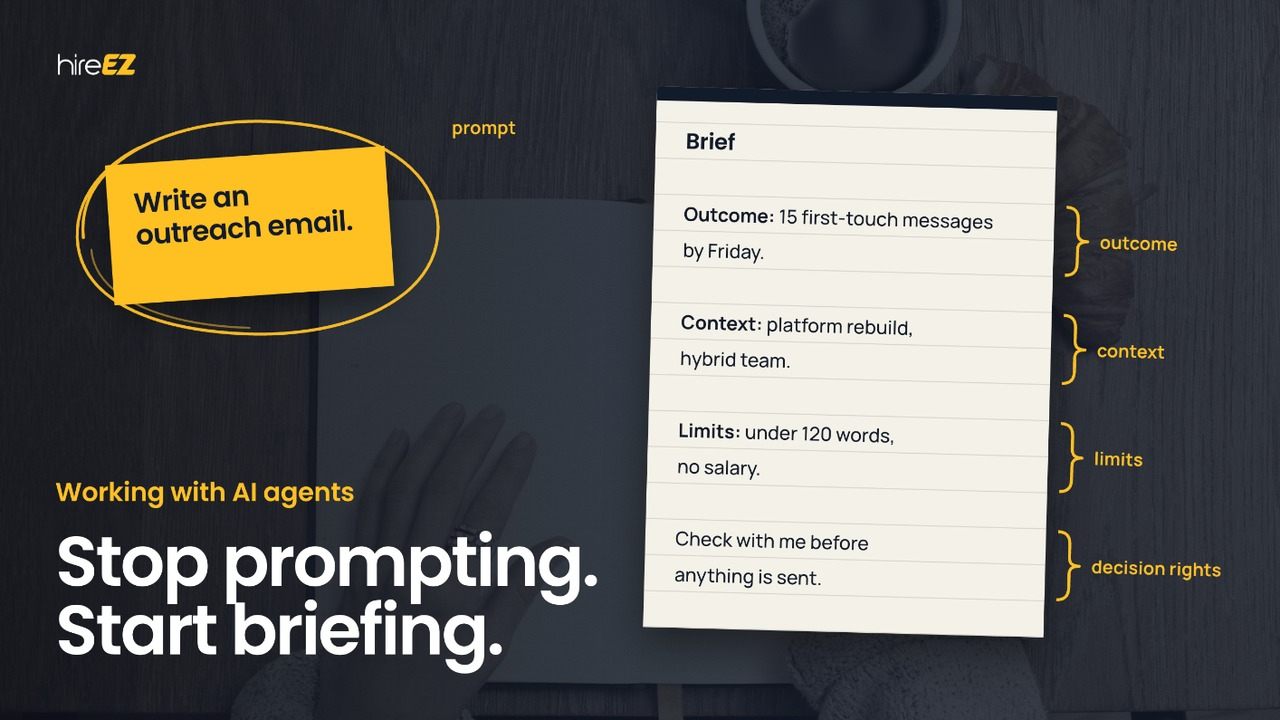
A prompt is an instruction for one step, such as "write an email" or "summarize this profile." A brief delegates an outcome: what you want, why it matters, the context, the constraints, what the agent can decide on its own and what it should bring back.
Prompts work for assistants, which respond one request at a time. Agents carry work across several steps, so they need briefs. That makes briefing a management skill, closer to running a good intake meeting or briefing a recruiting agency than to typing commands.
Prompt vs. brief at a glance
Prompt
Brief
Purpose
Get one output
Delegate an outcome
Scope
One step
Several steps, sometimes several stages
Context
Whatever fits in the sentence
Why the role is open, the team, the hiring manager's priorities
Decision rights
Not stated
What the agent can do on its own, and where it stops to ask
Output
A draft or an answer
Results and the reasoning behind them, in the format you asked for
Follow-up
A new prompt
Feedback that refines the same piece of work
Why agents need briefs, not prompts
A prompt assumes you'll check the result and write the next prompt. An agent carries the work forward, which changes what it needs from you:
Missing context compounds. A vague prompt produces one weak draft. A vague brief produces a weak shortlist, then weak outreach to that shortlist, then interviews with the wrong people.
The agent needs to know where to stop. Without decision rights, it either asks about everything or decides things it shouldn't. Setting those limits is the subject of How Much Autonomy Should an AI Recruiting Agent Have?
Consistency matters at scale. When ten recruiters brief the same agent ten different ways, candidates get ten different experiences. A shared brief format fixes that.
The brief becomes the record. When a hiring manager asks why the shortlist looks the way it does, the brief shows what was asked for.
The anatomy of a recruiting brief
A brief that works across the whole workflow has seven parts. Not every brief needs all seven, but briefs that go wrong usually skipped one:
The outcome. What done looks like, and by when, such as "a shortlist of 15 by Friday" or "first-round screens booked for next week."
The context. Why the role is open, who the hiring manager is and what they care about most.
Must-haves and nice-to-haves. Kept separate, so the agent doesn't treat a preference as a requirement.
Constraints. Location, schedule, budget range, tone of voice and anything that's off-limits.
Decision rights. What the agent can do on its own, and what needs your approval first.
Checkpoints. When to come back to you: after the first ten candidates, before anything goes to a candidate, or when something doesn't fit.
What to return. The format you want, and the reasons you want to see.
Draft first-touch messages for the 15 shortlisted candidates. Lead with the platform rebuild they'd own, and mention the hybrid schedule. Keep each under 120 words and leave out salary. I'll review every message before anything is sent, and flag anyone we've contacted in the last six months.
What changed: an outcome, a hook, constraints, a decision right and a checkpoint.
Screening
Prompt:
Screen these applicants.
Brief:
Run first-round screens for the 60 applicants on the sales associate req, using the approved question set. Flag anyone without quota experience, but don't decline anyone. By Thursday, send me a summary of your five strongest candidates and why.
What changed: the questions are fixed, the agent can flag but not decline, and the return format is clear.
Scheduling
Prompt:
Schedule interviews.
Brief:
Book panel interviews for the three candidates I advanced. The panel is the hiring manager and two team leads, for 45 minutes, sometime next week but not on Friday afternoon. Send each candidate the prep note, and tell me if a panel slot can't be filled.
What changed: who, how long, when, what to send and when to escalate.
A brief template your team can standardize
Copy this, fill in the brackets and delete what doesn't apply:
Outcome: [what done looks like], by [date]
Role: [title, team, location or remote]
Why it's open: [backfill, growth, new team]
The hiring manager cares most about: [one or two priorities]
Must-haves: [the few non-negotiables]
Nice-to-haves: [what would make someone stand out]
Constraints: [schedule, budget range, tone, anything off-limits]
You can do on your own: [for example, research, sourcing lists, drafts]
Check with me before: [for example, anything a candidate will see]
Come back to me when: [a checkpoint, such as after the first 10 candidates]
Return: [the format, and the reasons you want to see]
To make it a team standard:
Keep a shared library. Save the briefs that produced strong results, organized by role family.
Write the brief in the intake meeting. Fill in the template with the hiring manager, so the brief and the intake notes are the same document.
Agree on decision rights once. Set the "on your own" and "check with me" lines as team defaults, and change them only on purpose.
Revisit after each hire. Note what the brief got right and what you had to correct.
Common brief mistakes
Commands instead of outcomes. "Search job boards for Java developers" describes a step; "a shortlist of 15 backend engineers who've scaled payment systems" describes the result.
Hidden must-haves. If a role requires a security clearance, say so up front. The agent can't infer it from the job title.
Ten priorities at once. When everything is important, nothing is. Name the one or two that matter most.
No decision rights. Leave them out, and the agent will either ask too often or act when it shouldn't.
No checkpoint. Ask to see early results, so a wrong turn costs ten candidates, not a hundred.
Silence after the first round. The fastest way to improve results is to say what's off. "Too senior," "wrong industry" and "great, more like this" are all useful feedback.
How hireEZ approaches it
EZ Agent was designed to be briefed, not prompted. It works from the intent behind a brief, not just its words, and it treats a gap in the brief as a reason to ask, not a reason to guess.
What it does with a brief:
Reads the intent. It combines your words with the job context your team provides, such as intake notes and the Ideal Candidate Persona, to work out what the hiring manager actually needs.
Separates what matters. It tells must-haves from preferences, and checks with you when the brief doesn't make that clear.
Advises before it acts. It maps the talent market for the role, including salary benchmarks and competitive insights, and tells you when a requirement will make the pool thin or the timeline unrealistic.
Comes back with options. When context is missing, it lays out a few ways to proceed, with the tradeoffs of each, and lets you choose.
Leaves the decisions to you. Recruiters can review every outreach message before it's sent, and EZ Agent doesn't make decisions on your behalf without your approval.
Here's what that looks like with a thin brief, in an illustrative exchange:
Recruiter: Find senior Android engineers for the payments team.
EZ Agent: Before I start, two questions: is payments experience a must-have or a plus, and is the role Austin only, or open to remote in the US? Based on the market map, senior Android engineers with payments experience in Austin are a small pool. Three ways to go: stay in Austin and require payments experience, which is the most precise but slowest; open the search to remote in the US, which widens the pool; or stay in Austin and accept consumer apps at scale, with payments as a plus. Which should I start with?
The recruiter picks a path, and the brief gets sharper with every answer.
For a product walkthrough with example briefs for each stage, see the Mastering EZ Agent explainer. To watch EZ Agent ask clarifying questions and build a plan in one real session, see Martin Warren's talent bench session.
Bring one of your briefs, and see what EZ Agent does with it. Book a walkthrough
Frequently asked questions
What's the difference between a prompt and a brief?
A prompt asks for one output. A brief delegates an outcome, with the context, constraints, decision rights and checkpoints an agent needs to carry the work across several steps.
Do recruiters need prompt engineering skills to use an AI agent?
No. They need briefing skills, which are closer to running a good intake meeting: knowing the outcome you want, what matters most and when you want to be consulted.
What should a recruiting brief include?
The outcome, the context, must-haves and nice-to-haves, constraints, decision rights, checkpoints and what to return.
How long should a brief be?
Usually a short paragraph or a filled-in template of about 50 to 150 words: long enough to cover the outcome, priorities and limits, and short enough to read in a minute.
How do teams standardize briefs?
Use a shared template, write the brief during the intake meeting, agree on default decision rights and keep a library of briefs that worked.
What should an AI recruiting agent do when a brief is incomplete?
Ask before guessing. A good agent clarifies which requirements are must-haves, flags where the market won't support the brief, and offers a few options with their tradeoffs so the recruiter can choose how to proceed.