How Much Autonomy Should an AI Recruiting Agent Have?
October 13, 2026 —— Read time: 7 min
The short answer
An AI recruiting agent's autonomy should depend on the decision, not on the agent. Let it act on its own for low-risk, reversible work such as research, sourcing lists, data cleanup and scheduling logistics. Have a person review anything that reaches a candidate for the first time, such as outreach. And keep people deciding anything that changes a candidate's chances: advancing, declining and making offers.
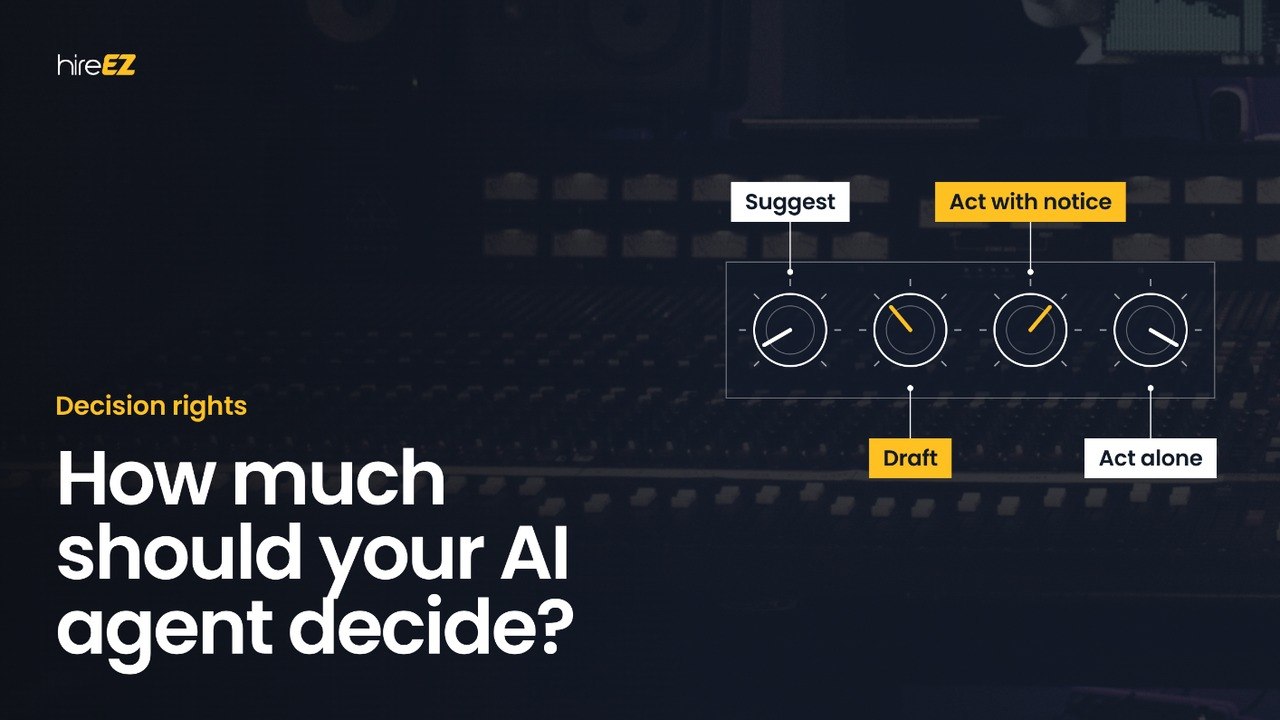
Treat autonomy as a dial you set task by task, not a feature a product has or lacks. Start conservative, measure how often people override the agent, and turn the dial up where it earns trust.
Why more autonomy isn't automatically better
Autonomy often gets pitched as the headline feature: the more an agent does without asking, the better. In recruiting, that's the wrong scoreboard, for four reasons:
Decisions land on people. A sourcing list is data; a rejection is a moment in someone's career. Mistakes on candidate-facing decisions cost trust, and your employer brand absorbs them.
Errors scale. A recruiter who misreads one profile makes one mistake. An agent with a flawed rule repeats it across every req until someone notices.
Someone has to own the decision. Hiring managers, auditors and candidates will ask who decided and why, and "the agent did" isn't an answer anyone accepts.
Rules are tightening. Some jurisdictions, such as New York City, already regulate automated tools that score or rank candidates. Check with your legal team before an agent's output drives a hiring decision.
The goal isn't the most autonomous agent. It's the right amount of autonomy for each task, with controls you can show.
Autonomy is a dial, not a switch
Instead of asking whether an agent is autonomous, set its autonomy for each task. Four settings cover most recruiting work:
Setting
What the agent does
What a person does
Good for
Suggest
Recommends options and explains why
Chooses, then carries out the step
Judgment calls such as shortlists and rankings
Draft
Prepares the work, ready to use
Reviews and approves before it's used
Anything a candidate will see, such as messages and screening questions
Act with notice
Carries out the step and records it
Can review, change or undo it
Reversible logistics such as approved follow-ups, scheduling and reminders
Act alone
Carries out the step within set rules
Spot-checks the log
Internal, low-risk work such as research, deduplication and data refresh
Most teams use all four at once. Research can run on its own while outreach waits for approval and offers stay entirely with people.
The delegation matrix
Here's how those settings map to everyday recruiting tasks. Use it as a starting point, then adjust for your roles, your risk tolerance and your local rules.
Task
Reaches a candidate?
Changes a candidate's chances?
Suggested setting
Researching the talent market for a req
No
No
Act alone
Building a sourcing list
No
Indirectly
Act alone, with a person reviewing the shortlist
Refreshing and deduplicating records
No
No
Act alone
Ranking applicants by fit
No
Yes
Suggest
Drafting outreach messages
Yes
No
Draft
Sending approved follow-ups
Yes
No
Act with notice
Writing screening questions
Yes
Yes
Draft
Running a screening conversation
Yes
Yes
Act with notice, using approved questions, with a person reviewing the results
Scheduling and rescheduling interviews
Yes
No
Act with notice, after a person advances the candidate
Advancing or declining a candidate
Yes
Yes
A person decides; the agent can suggest
Writing a decline message
Yes
No
Draft
Making an offer
Yes
Yes
A person decides
The pattern is consistent: the closer a task gets to a candidate's outcome, the further it moves toward Suggest or a person's decision.
Five questions to set the dial for any task
For tasks the matrix doesn't cover, run through these five questions. Each one can cap how far the dial goes:
Can it be undone easily? If not, the agent suggests and a person acts.
Does it change a candidate's chances? If it does, a person decides.
Will a candidate see it? If they will, a person approves it first, at least until the agent has a track record.
Can the agent explain its reasoning? If it can't show why, keep it at Suggest.
What happens if it's wrong 500 times? If the answer is a legal question or a public complaint, don't let it act alone.
If a task clears all five, it's a good candidate for Act with notice or Act alone.
Guardrails that make autonomy safe
Settings only work if the controls behind them are real. Six to ask for in any platform:
Configurable approval points. Choose, task by task, what needs a person's sign-off.
A record of what the agent did. Every action logged, with who approved it and when.
Reasons, not just results. Rankings and recommendations come with the evidence behind them.
Consistent criteria. The same job-related questions and standards for every candidate on a req.
Escalation when unsure. The agent asks instead of guessing when a brief is incomplete or a case is unusual.
A pause button. Anyone accountable can stop a workflow immediately.
Then sample the agent's work every week, especially early on, and track how often people override it.
How to raise autonomy over time
An agent should earn trust the way a new recruiter does: with a track record. A simple progression:
Start at Draft for anything candidate-facing. Let the agent prepare outreach, screening questions and decline messages, and have recruiters approve each one.
Measure the override rate. Track how often recruiters change or reject what the agent prepared, task by task.
Move one task, one setting at a time. When overrides stay low over several weeks, move that task one step, for example from Draft to Act with notice for approved follow-ups.
Write down who decides what. Keep a short decision-rights table, like the matrix above, and share it with hiring managers and legal.
Review every quarter. Revisit the settings as roles, volumes and rules change, and move a task back if quality slips.
The decisions about candidates themselves don't move: advancing, declining and offers stay with people at every stage.
How hireEZ approaches it
What EZ Agent is. EZ Agent is hireEZ's agent-native recruiting platform. Recruiters brief it in plain language, like a teammate, and it works across sourcing, outreach, screening and scheduling on one data foundation, on top of the ATS you already run. It's built around delegation, not automation: it comes back with options, and it doesn't make decisions on your behalf without your approval.
Where EZ Agent sits on the dial. Here's how its work maps to the settings above:
Setting
What EZ Agent does
Act alone
Researches the talent market for a req, including the open web when a task calls for it; sources from 45+ job boards and niche platforms plus your ATS; keeps your candidate records current
Suggest
Ranks candidates by job fit, with the highlighted context behind each ranking
Draft
Drafts personalized outreach that recruiters can review message by message. Drafts the interview plan, with the questions to ask and what a strong answer sounds like, then asks whether you want to look it over before anything is booked
Act with notice
Once you move a candidate forward, coordinates calendars across recruiters, hiring managers and interview panels and sends the invite
A person decides
Advancing, declining and offers stay with recruiters and hiring managers
EZ Agent drafts the plan, then asks before it acts.
hireEZ's sourcing, applicant matching and AI screening have also been independently assessed for bias, with the audit reports published on hireEZ's AI values page.
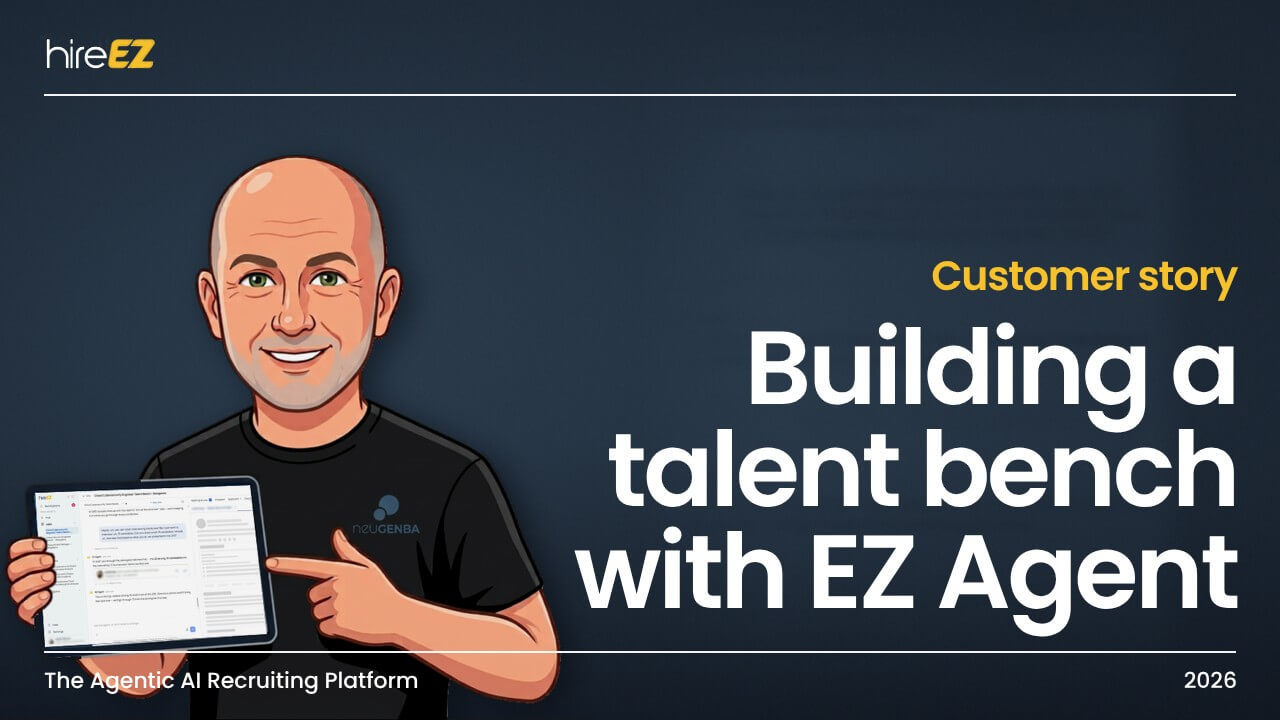
See it in action. Martin Warren, a Singapore-based talent sourcing and engagement leader, recorded a real session: he briefs EZ Agent to plan a talent bench for cloud security engineers, and you can watch it ask clarifying questions, calibrate a pool of 200 prospects and draft transparent outreach while Martin makes every call. Watch Martin Warren's talent bench session.
See where the approval points sit, on one of your own reqs. Book a walkthrough.
Frequently asked questions
How much autonomy should an AI recruiting agent have?
It depends on the task. Agents can act on their own for low-risk, reversible work such as research and data cleanup. A person should approve candidate-facing work first, and decisions that change a candidate's chances should stay with people.
Should AI reject candidates automatically?
No. An agent can rank applicants and draft decline messages, but the decision to advance or decline a candidate should be made by a person who can explain it.
What does human-in-the-loop mean in recruiting AI?
It means a person reviews, approves or decides at set points in an AI workflow, especially before anything reaches a candidate or changes their status.
Can an AI recruiting agent send outreach on its own?
It can, once a recruiter has approved the messages or the sequence. Most teams start by approving every first message, then let the agent send approved follow-ups with notice.
How do you audit an AI recruiting agent?
Keep a log of what it did and who approved it, sample its work regularly, track how often recruiters override it, and make sure its recommendations come with reasons.
Are there laws about using AI in hiring?
In some places, yes. New York City, for example, regulates automated tools used to score or rank candidates. Rules vary by location, so check with your legal team.