From Boolean Strings to Briefs: How AI Changed Candidate Search
October 10, 2026 —— Read time: 6 min
The short answer
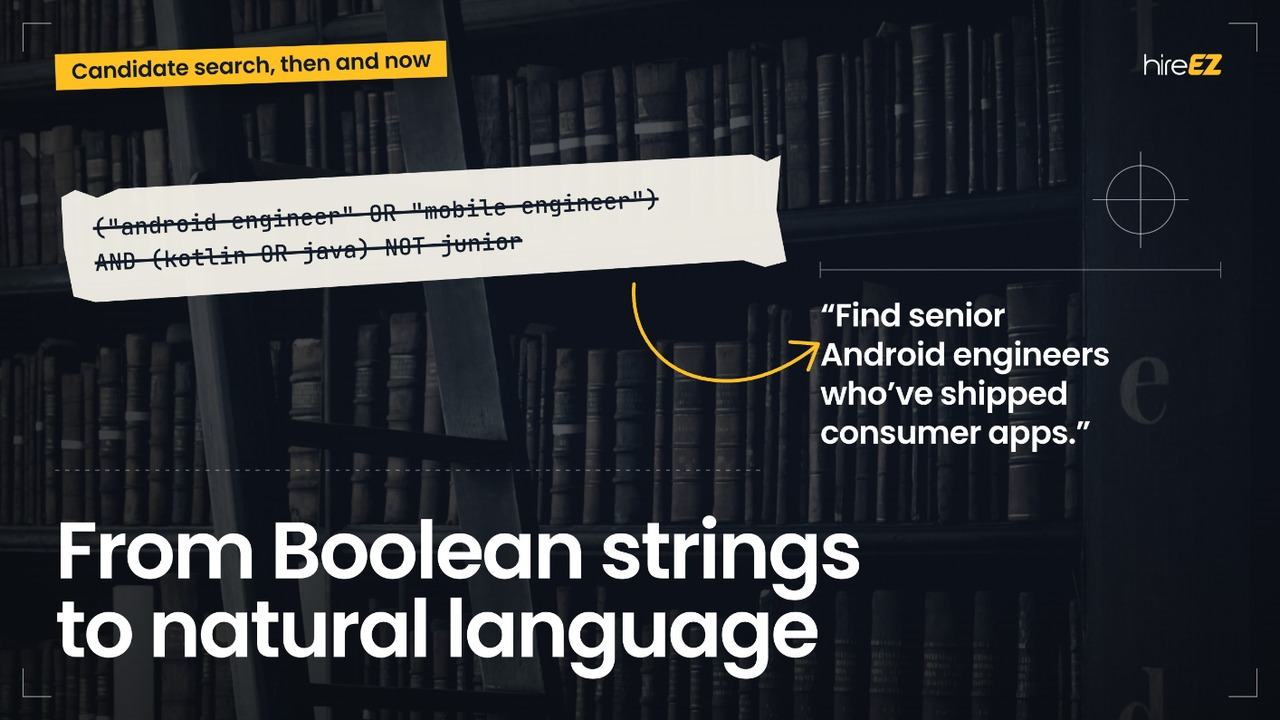
Candidate search has moved through three eras. Boolean strings matched keywords using operators such as AND, OR and NOT. Semantic search matched meaning, so related titles and skills counted too. Now recruiters can write a brief in natural language, covering the outcome they want, the context and the constraints, and an AI agent plans the searches, runs them across sources and comes back with a shortlist and the reasons behind it.
Boolean isn't dead. It's still the most precise tool for exact must-haves and for checking a search. It's just no longer where search starts.
Three eras of candidate search
Each era solved the previous one's biggest problem:
Era
How you search
What it gets right
What it misses
Boolean strings
Keywords joined with AND, OR and NOT, plus quotes and brackets
Precise, repeatable and easy to audit
Anyone who describes the same skill in different words; strings grow long and brittle
Semantic search
A short query; the system matches meaning, related titles and adjacent skills
Finds people a Boolean string misses
Still one query at a time, and the recruiter interprets every result
Natural-language briefs
A brief describing the outcome, context and constraints; an agent plans and runs the searches
Searches several ways across several sources, explains each match and refines from feedback
Only as good as the brief and the data behind it
The skill that matters shifted with each era: from writing strings, to choosing terms, to describing what good looks like.
One search, three ways
Here's the same req written for each era: a senior Android engineer who has shipped consumer apps, with fintech experience as a plus, based in Austin or remote in the US.
1. The Boolean string
("android engineer" OR "android developer" OR "mobile engineer") AND (kotlin OR java) AND ("consumer app" OR "play store" OR B2C) AND (senior OR lead OR staff) NOT (intern OR junior)
It's precise, but it only finds people who used these exact words. A strong engineer whose profile says "built the Android app our customers use every day" may never show up.
2. The semantic query
Senior Android engineer with consumer app experience
The system understands that "mobile developer" and "Kotlin" are related, so it finds more of the right people. But it's still one query, and the recruiter has to work out which results fit, run the next search and keep track of the rest.
3. The natural-language brief
Find 20 senior Android engineers who have shipped consumer apps with a large user base. Fintech experience is a plus, not a must. Austin or remote in the US. Start with people already in our ATS, then search outside it. Show me why each one fits, and flag anyone who has moved into management.
The brief states the outcome, separates must-haves from nice-to-haves, and says where to look first and what to return. An agent can turn it into several searches across sources, check each candidate against the brief, and come back with a shortlist it can explain.
What natural-language search understands that Boolean can't
Language models read a profile the way a good sourcer does, not as a bag of keywords. In practice, they can pick up:
Different words for the same skill. "Built our mobile checkout" and "Android payments" can describe the same experience.
Adjacent skills. Someone strong in Kotlin and Jetpack Compose is a likely Android match, even if "Android" appears only once.
Seniority signals. Leading a migration or mentoring engineers says more about level than a job title does.
Career direction. Whether someone is moving toward hands-on work or away from it.
Context from the brief. "Consumer apps with a large user base" is a judgment about scale that no Boolean operator can express.
More than one language. Language models can work with profiles and briefs written in many languages, not just English.
The tradeoff is precision. A model makes judgment calls, so it needs a clear brief and someone checking its reasoning.
When Boolean still wins
Boolean is still the right tool in four situations:
Hard requirements. A license, a security clearance or a certification either appears or it doesn't, and an exact match beats a judgment call.
Repeatable, auditable searches. When you need to show exactly how a pool was built, a saved string is easy to explain and rerun.
Rare, exact terms. A niche framework, a specific patent area or an uncommon product name is often faster to find with a quoted term.
Checking an agent's work. A quick string is a good way to spot-check whether a shortlist missed obvious candidates.
The best sourcers use both: briefs to explore, strings to verify.
How to write a search brief
A good search brief reads like a strong intake summary. Six parts cover most roles:
The outcome. How many candidates you want, and by when.
Must-haves. The few requirements a candidate can't do without.
Nice-to-haves. What would make a candidate stand out, labeled as optional.
Signals of fit. What success in the role looks like, such as scale, industry or the kinds of problems solved.
Where to look first. Your ATS and past applicants, then the wider market.
What to return. The shortlist format, and the reasons you want to see for each match.
Then treat the first results as a calibration round. Say what's right and what's off, such as "too senior" or "not enough consumer work," and let the search adjust. Briefing an agent across the whole workflow, beyond search, is the subject of Prompts vs. Briefs.
Moving a sourcing team from strings to briefs
The shift is a change in skills, not a tool swap. A practical way to make it:
Keep the string library. Your best Boolean strings hold years of market knowledge. Turn them into reference material for writing briefs and checking results.
Pair every brief with a spot check. Early on, run a quick string against each shortlist to see what the brief missed.
Measure shortlist acceptance. Track how many candidates hiring managers accept from brief-driven shortlists compared with string-driven ones.
Share the briefs that work. Collect the briefs that produced strong shortlists, and use them as templates by role family.
Reposition sourcers as market experts. Less time writing strings means more time on the market itself: talent maps, competitor moves and calibrating with hiring managers.
How hireEZ approaches it
hireEZ grew up in sourcing, so we've seen all three eras from the inside. EZ Agent is where that leads: recruiters brief it in natural language, and it turns the brief into a search plan across 45+ job boards and niche platforms plus your ATS, on a foundation of 1B+ profiles, researching the open web when a task calls for it.
It ranks candidates by job fit with the highlighted context behind each match, asks what's missing when a brief is incomplete, and treats your feedback on the first results as calibration. It doesn't make decisions on your behalf without your approval.
No. It's no longer where most searches start, but it's still the best tool for hard requirements, auditable searches and spot-checking an AI shortlist.
What is natural-language search in recruiting?
Searching by describing who you need in everyday language instead of keywords and operators. Language models interpret meaning, related skills and context, and an agent can turn the description into several searches.
What's the difference between semantic search and an AI recruiting agent?
Semantic search improves a single query by matching meaning. An agent takes a whole brief, plans and runs several searches across sources, checks candidates against the brief and comes back with a shortlist it can explain.
How do you write a good search brief?
State the outcome, the must-haves, the nice-to-haves, the signals of fit, where to look first and what to return. Then refine the brief based on the first results.
Do recruiters still need sourcing skills?
Yes, but the skills shift. Knowing the market, writing a clear brief and judging fit matter more than writing long strings.