How to Choose AI Recruiting Software for a Health System: A Buyer's Checklist
—— Read time: 7 min
The short answer
The right AI recruiting software for a health system works on top of the ATS you already have, covers every role you hire for (not just nurses), understands clinical credentials and shifts, and proves its results with your own data.
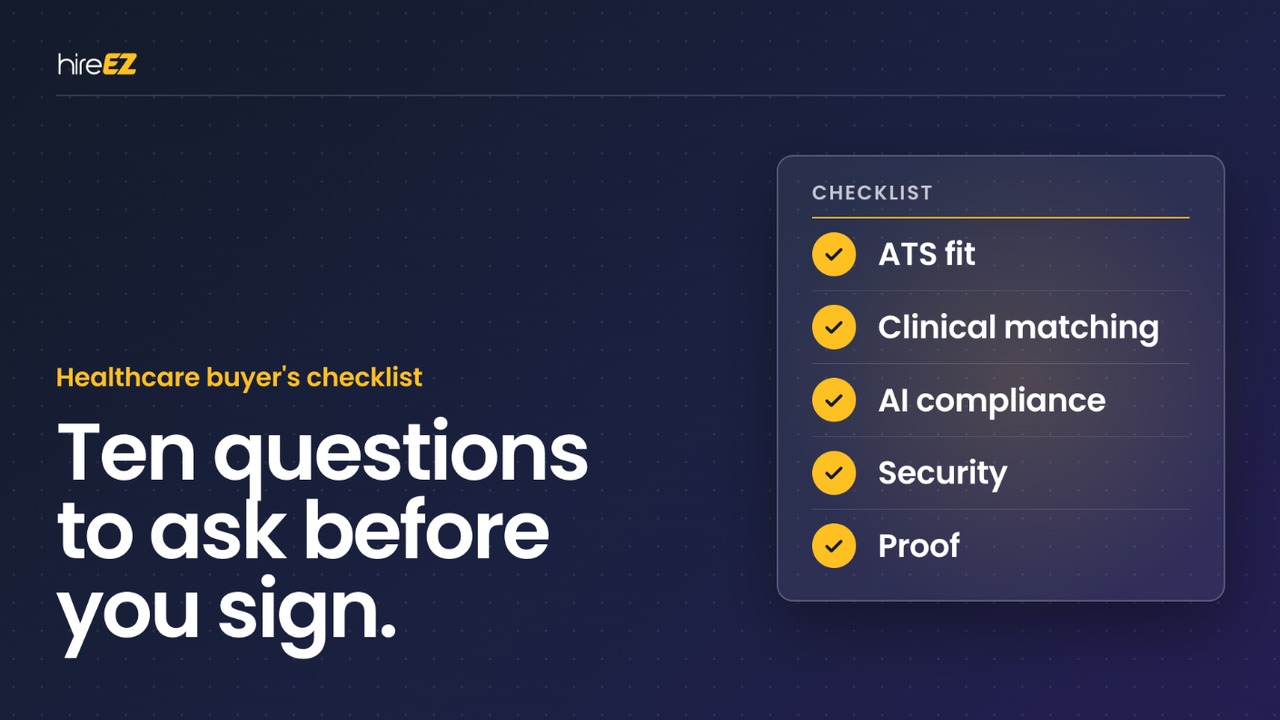
Before you sign, ask every vendor the ten questions below, from ATS fit and clinical matching to AI compliance and security. Then test the finalists on two of your hardest units, with real requisitions.
Specialist tools or one platform?
The first decision isn't which vendor. It's which kind of tool. Some products specialize in one healthcare workflow, such as a nurse marketplace or a scheduling add-on. Others are platforms that run sourcing, screening, scheduling and analytics for every role, on top of your ATS.
Specialist tools can be strong at their one job. The tradeoffs show up at health-system scale:
Your hiring mix is wider than nursing. Health systems also hire allied health, IT, revenue cycle, finance and facilities staff. A nursing-only tool leaves the rest of the team on other systems.
Each point tool adds a login, a contract and a data silo. Recruiters end up copying candidates between systems, and no one sees the whole pipeline.
Every tool still needs your ATS. Whatever you buy has to work with the system of record you already run.
A practical rule: if one workflow is your only problem, a specialist may fit. If the problem is speed and cost across your whole recruiting operation, evaluate platforms that sit on top of your ATS.
The 10-point checklist
1. Does it work on top of our ATS?
Your ATS is your system of record, and replacing it is a multi-year project.
Ask: Which ATS do you integrate with natively, and what syncs both ways: candidates, notes, stages and statuses?
Red flag: "We replace your ATS," or an integration that only exports files.
2. Does it cover our whole hiring mix?
A health system hires far beyond the bedside.
Ask: Can recruiters use the same platform for nurses, allied health, IT, revenue cycle and facilities roles?
Red flag: separate tools or contracts for clinical and non-clinical hiring.
3. Does matching understand clinical requirements?
Job titles vary from one hospital to the next; credentials don't.
Ask: Can we search and screen by license state (including multistate licenses), certifications such as CCRN or BLS, specialty, unit and shift preference?
Red flag: keyword matching on job titles alone.
4. Can it rediscover the candidates we already have?
Past applicants and former contract nurses are often your fastest hires.
Ask: How do you find past applicants in our ATS, and keep their records current?
Red flag: every search starts from zero, outside your own database.
5. Can it screen at volume, around the clock?
Nurses apply after shifts, and the fastest response usually wins.
Ask: How are applicants screened after hours, and who reviews the results before a nurse manager sees anyone? Is there a fraud check?
Red flag: screening that advances or rejects candidates with no human review.
6. Does scheduling work around shifts?
Interviews offered only during business hours miss night and weekend staff.
Ask: Can candidates book interviews outside business hours, and can it coordinate nurse managers' calendars?
Red flag: scheduling links that only offer weekday daytime slots.
7. Does it give us market data we can trust?
Plans built on the wrong market add months to time-to-fill.
Ask: Can we see supply, pay and competing employers for a role and location, with a date and source behind every figure?
Red flag: confident numbers with no date, source or stated limits.
8. How does it handle AI governance and compliance?
Rules are tightening: Colorado's AI law takes effect January 1, 2027, with notice and transparency requirements, and New York City already requires bias audits for automated hiring tools. In one 2025 industry report, 75% of HR leaders named bias as a top concern when evaluating AI tools, second only to data privacy.
Ask: Do people make every hiring decision? Have you published independent bias audits? How do you support notice and disclosure to candidates?
Red flag: no published audit, or "the AI decides."
9. Does it meet our security standards?
Your security team will review the vendor before anyone signs.
Ask: Which certifications do you hold, such as SOC 2 Type 2 and ISO 27001? Do you support SSO and SAML? How is candidate data retained and deleted?
Red flag: certifications "in progress" with no date.
10. Can it prove results with our own data?
Benchmarks are a starting point, not proof.
Ask: How will we measure time-to-fill and cost per hire before and after, using our own ATS data? How long until we see value?
Red flag: results shown only as vendor benchmarks, with no plan to measure yours.
How to run the evaluation
A demo shows what a product can do. A pilot shows what it does for you. Four steps keep the evaluation fair and fast:
Pick two hard-to-fill units and record a baseline. Note current time to first contact, time-to-fill and contract labor use for each.
Run the finalists on real requisitions. Same roles, same weeks, same recruiters. Compare who surfaces qualified nurses, how fast they're contacted and how many reach interviews.
Bring in security, legal and IT early. Share the vendors' answers to items 8 and 9 before the pilot ends, so reviews don't delay the decision.
Take the numbers to finance. Turn days saved into revenue protected with the healthcare cost-of-vacancy calculator, then weigh it against the platform's cost and the tools it replaces with the ROI calculator.
hireEZ's AI doesn't make employment decisions; people do. hireEZ has published independent bias assessments by Armilla AI for its sourcing platform, Applicant Match and AI Screening
Customer benchmarks of a 50% reduction in time-to-fill and a 60%+ reduction in hiring costs, and analytics that measures your actual time-to-fill from your ATS data; prove value in 90 days
Bring this checklist to a walkthrough, and we'll answer it on your requisitions.Book a walkthrough
Frequently asked questions
What should a health system look for in AI recruiting software?
Software that works on top of your existing ATS, covers clinical and non-clinical hiring, understands licenses, certifications and shifts, screens around the clock with human review, and proves results with your own ATS data.
Should a health system buy a healthcare-specific recruiting tool?
A specialist can fit if one workflow is your only problem. If you need speed and lower cost across every role you hire for, a platform that sits on top of your ATS avoids adding logins, contracts and data silos.
What should we ask AI recruiting vendors about compliance?
Ask whether people make every hiring decision, whether the vendor has published independent bias audits, and how it supports notice and disclosure to candidates. Colorado's AI law takes effect January 1, 2027, and New York City already requires bias audits for automated hiring tools.
How should we pilot AI recruiting software?
Pick two hard-to-fill units, record a baseline, run the finalists on real requisitions at the same time, involve security and legal early, and take the results to finance.
How long does it take to implement AI recruiting software?
It depends on the vendor. hireEZ deploys in weeks on top of your existing ATS and is built to prove value in 90 days.