
Story highlights
-
The challenge
Recruiters who limit themselves
When a recruiter says they can’t find anyone, Trent checks the top of the funnel: hiring 10 from 1,000 candidates means you want 2,000 at the top.
Watch at 1:08 -
The solution
Reports, pipelines and Insights in hireEZ
Campaign reports show what outreach works, CRM pipelines show where candidates drop out, and Insights shows where talent comes from and goes.
Watch at 2:30 -
The result
Coaching built on data
Trent coaches recruiters with a weekly success routine, lets top performers teach their peers and plans hiring with near real-time benchmarks.
Watch at 3:15
How Trent Cotton coaches a data-driven recruiting team with hireEZ
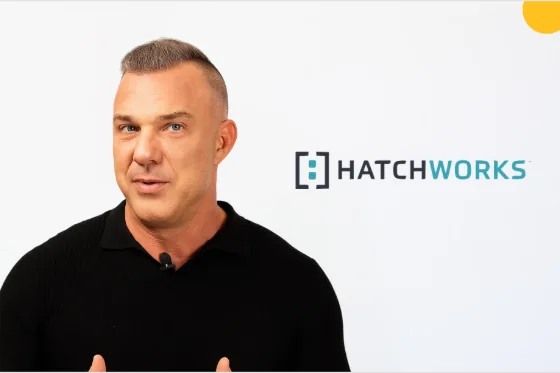
Trent Cotton leads talent and culture at HatchWorks AI, from talent development to talent acquisition. He calls hireEZ the team’s secret weapon, for talent insights, recruiting strategy and advising clients. In this speakEZ, he walks through the reports and tools he uses to coach recruiters and plan hiring.
Start with the top of the funnel
Trent’s rule for recruiting comes from W. Edwards Deming: bring data. When a recruiter is stuck, the first thing he opens is the funnel.
“If you have to go through a thousand candidates to hire 10, then you should probably have 2,000 candidates sitting at the top of that funnel. It's just basic math.”
A good-fit list only matters if someone acts on it. That’s why he coaches each recruiter toward a success routine, a habit our guide to candidate sourcing strategies also recommends: widen the search before you blame the market.
A/B test outreach to see what resonates
Irrelevant outreach is Trent’s pet peeve. hireEZ’s campaign reports show deliveries, replies and click-throughs by date and by campaign, so the team can test messages against each other.
“We found out that people will normally click within the emails that link to a video versus linking to a PDF about our culture.”
So new nurture and outreach campaigns now lean on video. For more on testing and structuring messages, see how to craft email sequences that get responses.
Let top performers coach their peers
The same reports break results down by recruiter, and Trent uses that to spread what works.
“If I'm looking at one particular recruiter and their open rate is twice what everybody else's is, I'm going to get them to lead a webinar, lead a best practices routine, or share with the rest of the team.”
“Recruiters will listen to their peers for best practices more than they listen to their leaders.”
Proactive pipelines, tracked in the CRM
“I am not a reactive recruiting organization. I hate it.”
Instead, HatchWorks identifies the competencies, skills and titles it needs on hand, builds talent pipelines and tracks every candidate’s life cycle in hireEZ’s CRM. When candidates fall out between screening and the hiring manager, Trent goes straight to the cause, often by bringing back the Insights report the hiring manager agreed to at intake.
“This is how you defined success. What's changed?”
Insights for benchmarking and competitive analysis
For large organizations, Trent says hireEZ Insights shows where people go when they leave and where your best hires come from.
“If I know that I can recruit from IBM all day long and twice on Sunday, I'm going to double down on IBM.”
Because the data follows how often people move and update their profiles, it’s close to real time, unlike industry reports that are six to 18 months behind. That lets him check, for example, whether losing full stack developers in years four to six is normal, and fix it if it isn’t.
“This was a must-have. This was a non-negotiable for me.”
Key moments
- 0:02Meet Trent Cotton
- 0:46Data-driven recruiting: start with the funnel
- 2:30A/B testing outreach: video beats PDFs
- 3:15Let top performers coach their peers
- 4:37Talent pipelines instead of reactive recruiting
- 6:41Performance reports: a Friday routine
- 7:10Insights: where talent comes from and goes
- 8:39Competitive talent analysis
Transcript
Trent Cotton, vice president of talent and culture at HatchWorks AI. From the video’s captions, edited for readability.
Hi, I'm Trent Cotton. Welcome to my speakEZ. As the vice president of talent and culture at HatchWorks AI, I get the fun part of HR, so everything from talent development to talent acquisition, performance coaching, and really helping with the overall strategy for how we're going to continue to grow with the best talent in the market.
hireEZ is our secret weapon. We use it to develop talent insights to help us create our recruiting strategy and also advise our clients. We also use it to nurture, to identify and, most importantly, execute on a flawless talent program. So if you're interested, join me in my office. Let's check it out.
I am huge about data. If you've listened to me, if you've read anything that I put out there, I love W. Edwards Deming's quote, "In God we trust, and everyone else must bring data." So I apply that to recruiting as well. Whenever I'm sitting down with one of the team members and they're talking about a struggle or an obstacle, I go into here, because I want to look at what the funnel looks like.
A lot of times recruiters say we can't find anyone, and they're looking for this very small skill set. They've limited themselves too much. As a former salesperson, you always look at the top of the funnel, because if you have to go through a thousand candidates to hire 10, then you should probably have 2,000 candidates sitting at the top of that funnel. It's just basic math.
So I love that they actually go through the recruiting funnel: how many are not reviewed. Selecting them as a good fit is fantastic, but if you don't do anything with it, it's worthless. Recruiters are so busy, we're constantly chasing that next shiny light. Sometimes we need to just really ground ourselves and create a success routine, and this allows me as a leader to be able to coach my team to develop that success routine.
I love looking at converted qualified. Is it 99%? That's really good. The emails and the click-throughs, this is huge. I don't know about you, but I hate getting an email or an InMail or something that asks me for something that's completely irrelevant. I get people all the time going, "Would you be interested in this commercial lending position?" I haven't been in lending for like 20 years. Why in the hell would I? Really fine-tune your approach.
This allows us from a marketing standpoint to say, okay, which emails resonate the most? We've done a couple of different A/B tests. We found out that people will normally click within the emails that link to a video versus linking to a PDF about our culture. So when we're creating new nurture campaigns or new outreach campaigns, we're going to leverage video a lot more. We also can do some A/B testing on a very long email that's got some GIFs and some pictures and all this, versus one that's very short, sweet and to the point and ends with the video, and we can see what's the response rate, what's the click rate.
I can also look at it by team members. So if I'm looking at one particular recruiter and their open rate is twice what everybody else's is, I'm going to get them to lead a webinar, lead a best practices routine, or share with the rest of the team. For leaders this is important, because I find a lot of times that recruiters will listen to their peers for best practices more than they listen to their leaders. And this is also a great way for you to identify those who are doing great things and elevate them, and allow them an opportunity to coach their peers. So definitely, definitely start with the overview.
I mentioned the campaigns. We can look at the email adoption, number of replies, the click-through rate at 42, and this is just for the last 7 days, and it's been a quiet week, thankfully. So we can see that we delivered 502, 61 replied, and we had a click-through rate of 42, so that's right at 10%, which is not bad. We can also look at it by date, we can look at it by campaign name. So this is where you can start looking and see which campaigns are the most successful, and you can back into it and go, okay, well, why are these more successful? What's different from this one versus another one? That's called A/B testing.
I also like to look at projects. For what we do, I am not a reactive recruiting organization. I hate it. I hate it. I spent the first part of my career doing that, and I will never, ever, ever go back. So what we do as an organization is we try to identify what are the most common competencies, skill sets, job titles, whatever, that we need to be able to have in our back pocket and ready to go. Then what we do is we create talent pipelines, and we use the CRM aspect of this amazing tool to be able to track the life cycle of that candidate.
So what I can do is I can actually get in and see, for different pools, where are we sitting. Again, it's been a quiet week and we've been moving people back and forth, but I can look at how many candidates are moving throughout the process and where are we losing them. If we see one week that we've got 78 that are a good fit, and then the next week, of that 78, 40 of them are in recruiter screening, and then we get another 30 that go to the hiring manager, and then all of a sudden two are with the hiring manager, I'm immediately going to go, what's going on?
So I'm going to get with the hiring manager and say, where are we off? Then I'm going to get with the recruiter and say, let's fine-tune our search. Or, which is more commonly the cause, usually I have to sit down with the hiring manager and say, didn't we agree to these five things? So why are you grading these candidates by 10? Do we need to go back and redo the search? So again, that's why starting with that Insights PDF and sending it to them is a great way to call it back to their memory and say, okay, this is how you defined success. What's changed?
And then of course diversity. I love looking at how many have we qualified, contacted. This is taking DEI and really putting some really strong analytics on the top of the funnel. Not how many did you hire, how many did you retain, but how many are you actually reaching out to, because if you can nail that, the rest of it is going to just fix itself.
So if you don't spend time in the performance reports, you're truly missing out. And even as a recruiter, I would get in and I'd be looking at which one of my emails do better, what does my candidate flow look like. Take a moment every Friday afternoon. It's a perfect time to do that. That way you can go into next week with success strategies rather than just repeating the same insanity that you did this week that apparently didn't work.
For large organizations, and like very large organizations, the Insights is something that's pretty incredible. I'm spoiled by hireEZ. A lot of times I get to beta test things, and I got to beta test this a year or two ago, and it is mind-blowing, the analytics that it was able to give me. So if you're trying to understand where people are going from a retention standpoint, you know, we've turned over 40% within the retail division, where did they go? hireEZ can tell you. They can also tell you where most of your people are coming from. Why is that important? Well, if I know that I can recruit from IBM all day long and twice on Sunday, I'm going to double down on IBM.
It also gives you some really interesting comparisons or benchmarks against the industry. Throughout my career it's always been, well, our turnover is high compared to the industry, and there's some industry reports out there, but usually they're about 18 months, or six months at best, behind. This is leveraging how often people are moving and updating their stuff in LinkedIn. hireEZ is right there too, so this is as close to real time as you can possibly get, which means that if you're consulting your client, you can go on the offense with them. It's just powerful, powerful data.
And competitive talent analysis. I can look at, all right, this is when we start losing full stack developers, between years four and six. Is that common in the industry? If it isn't, then I need to drill down and see what's going on. But if it is, if I can fix that, then my retention rate is going to be higher than my competitors', which means that I'm going to have a competitive edge over them. And then of course the diversity and inclusion. You just got to check it out. I can't even get into that, it just makes me really, really excited.
And then some strategic decision making. You can generate the report, you can download the report, and I think there was a way also that you could automate it, which is fantastic. It's one less report that you have to send out. But if you're not using Insights, definitely check it out. We're not using it because we're kind of small. We're a bootstrap, we have to be very, very careful about where we spend our money. But whenever I was with very large organizations, running large talent organizations, this was a must-have. This was a non-negotiable for me.
Well, I hope you enjoyed my little tour of hireEZ and the speakEZ. I don't know about you, but most of the time whenever I hear speakeasy, it involves a drink, so after all of this today, that's exactly where I'm going. If you want to catch up with me, not at the speakeasy, you can catch me on trentcotton.com. Of course you can follow me on LinkedIn and Twitter. I am always open to help anyone in the profession make their talent strategy better.