Questions to Ask Any AI Recruiting Agent Before You Buy
October 10, 2026 —— Read time: 10 min
The short answer
Every AI recruiting agent demos well on a sample req. The questions that matter make it show its work on yours: how it's built, which stages it covers, what it does with a vague brief, what data it works from, what you control, how it handles your data and what it really costs.
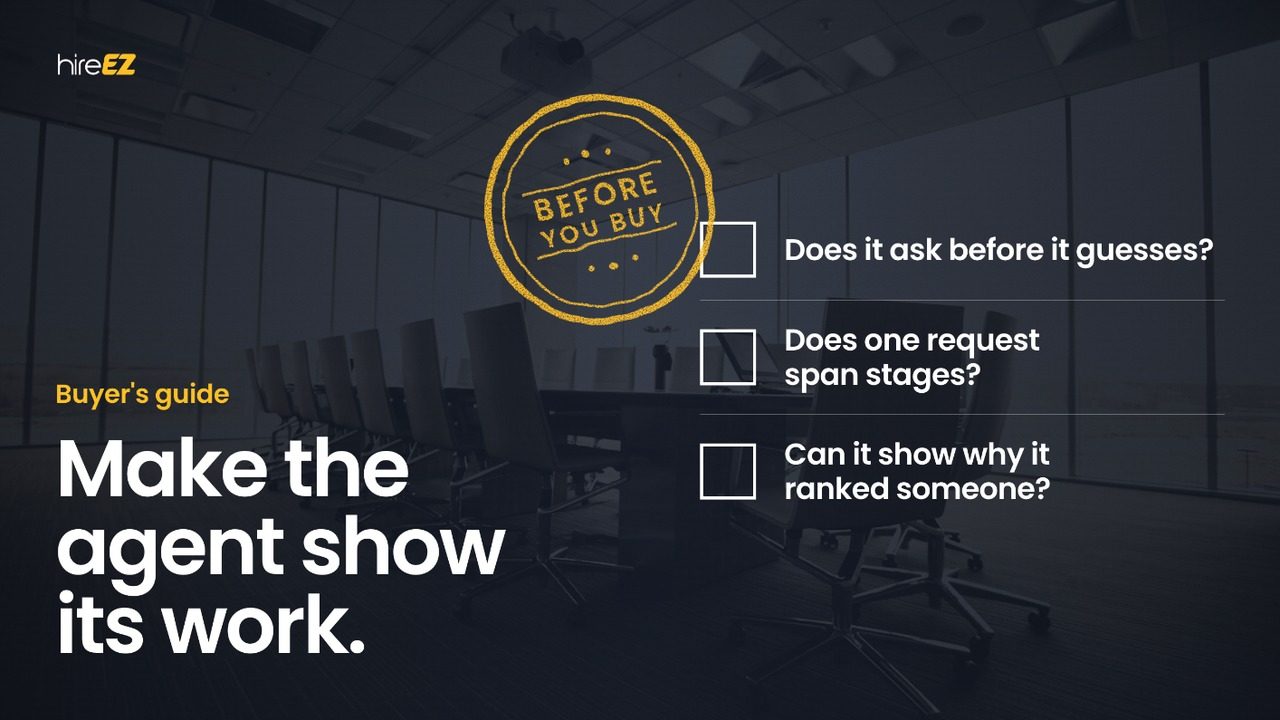
Ask for answers you can see, not adjectives you have to trust. The strongest test is simple: bring a live req, brief the agent in front of you, and watch what it asks, what it does and what it brings back.
How to use these questions
Send them before the demo. Vendors who know the questions in advance can show real answers instead of a standard script.
Ask to see, not hear. For each question, ask the vendor to demonstrate the answer on one of your live reqs.
Bring the right people. Recruiters judge the day-to-day experience, TA operations the workflow, IT and security the data questions, and legal the controls.
Score each answer. Mark it strong, weak or a red flag, using the tables below. One red flag on control or data can outweigh several strong answers elsewhere.
Use the same req for every vendor. One brief across all of them makes the differences obvious.
How the agent is built
These questions tell you whether you're looking at an agent-native platform or an agent added to existing software:
Question
A strong answer
A red flag
Is the agent the product, or a feature added to an existing product?
The agent sits at the center and works across the platform
"It lives in our sourcing module"
What happens when I ask for something outside the page I'm on?
It does it, or asks what it needs in order to do it
It sends you to another page or another tool
Is the workflow fixed in advance, or does it adapt to each job?
It adapts to the req and its context
Every req follows the same predefined steps
How does my team shape how it works?
With your own job context, such as intake notes, personas and playbooks
Only through vendor configuration
Coverage and handoffs
Coverage decides whether you're buying one layer or another tool to coordinate:
Question
A strong answer
A red flag
Which stages can one request cover?
It shows one request moving from sourcing to outreach to scheduling
A separate agent for each stage
What happens at the handoff between stages?
Nothing is re-entered; every stage works from the same data
Exports, imports or copy and paste
Does it handle inbound applicants as well as outbound sourcing?
Both, in the same place
Only one, with a partner tool for the other
If I need several agents, who coordinates them?
One agent covers the workflow
"You can connect them through our API"
If the answer involves several agents plus a layer your team builds to connect them, compare the full cost, not each tool's price. hireEZ Alternatives walks through that math.
Intent and incomplete briefs
This is where agents differ most, and where most demos don't go. Give the agent a deliberately thin brief and watch what happens:
Question
A strong answer
A red flag
What does the agent do with a vague brief?
It asks clarifying questions before it starts
It proceeds and fills the gaps silently
Can it tell a must-have from a preference?
It separates them, and checks when the brief is unclear
It treats every word as a requirement
Will it tell me when the market won't support my requirements?
It flags a thin pool or an unrealistic timeline, with market data
It always returns a full list
What does it bring back when context is missing?
A few options, with the tradeoffs of each
One answer, with no reasoning
Prompts vs. Briefs covers what a good brief includes, and what a good agent does with a weak one.
Data and context
An agent is only as good as what it can see:
Question
A strong answer
A red flag
What candidate data does it search?
Your ATS plus a broad external market, with named sources
"Our proprietary database," with no detail
How current is the data?
Records are refreshed, and it shows when a profile was last updated
No answer, or "we update regularly"
Can it use our intake notes, personas and past hires?
Yes, and you can see how they shape the shortlist
Only the job description
Does it learn from our feedback on a req?
Feedback on early results changes the next ones
Every search starts from zero
Ask to see a ranked candidate with the reasoning behind the ranking. If the vendor can't show why someone is on the list, you won't be able to explain it to a hiring manager either.
Control, approvals and audit
These questions decide whether you can stand behind what the agent does:
Question
A strong answer
A red flag
Which actions can I require approval for?
You set approvals task by task, such as reviewing every message before it's sent
Autonomy is all or nothing
Can I see a log of what the agent did?
Every action is recorded, with who approved it and when
No log, or logs only on request
Does it explain its rankings and recommendations?
Each one comes with the evidence behind it
"Trust the model"
Has the AI been independently assessed for bias, and can I see the results?
Bring IT and security in early for this round; the answers belong in the contract, not just the demo:
Question
A strong answer
A red flag
Do you train AI models on our data?
A clear, written answer, with an opt-out if they do
A vague or verbal answer
Where is our data stored, and for how long?
Specific regions and retention periods, written into the contract
"Industry standard"
Does the agent respect each user's permissions?
It can see and do only what that user could
One shared service account
How does it work with our ATS?
It reads and writes the records you choose, in both directions, with no migration
A one-way export, or a new system of record
Can our team's AI assistants work with it?
A supported, permissioned connection, such as an MCP server or an API
No integration path
Cost and proof
Question
A strong answer
A red flag
Is the agent generally available, and can I see it working for live customers?
Yes: customer sessions you can watch, and references you can call
A roadmap demo, a waitlist or a private beta
How is it priced?
One clear model, such as per seat or per platform, with what's included
Per agent, with add-ons for each stage
What will it cost to cover the whole workflow?
A single quote for every stage you need
Separate quotes, plus integration work you'd own
Can we test it on our own live reqs before we sign?
Yes, with a defined trial and success measures
Demos on sample data only
What results can customers show, and can we talk to one?
Named outcomes, and a reference call with a team like yours
Anonymous case studies only
How long until we see value?
A specific deployment plan, measured in weeks
An open-ended implementation
Agree on success measures before the trial starts, such as time to shortlist, response rates or reqs per recruiter, so the decision rests on your numbers rather than the vendor's.
If two agents look equally capable in the demo, decide on the whole picture, not on price or contract length alone: proof from live customers, the data foundation underneath, time to value, the quality of support and the vendor's track record in recruiting.
How hireEZ answers these
We wrote these questions to be fair to every vendor, including us. Here are our short answers:
How it's built: EZ Agent is an agent-native recruiting platform. The agent is the platform, on top of the ATS you already run.
Coverage: it works across sourcing, outreach, screening and scheduling on one data foundation, for inbound applicants as well as outbound sourcing.
Briefs: it reads the intent behind a brief, asks before it guesses, flags when the market won't support a requirement and comes back with options.
Data: it searches 45+ job boards and niche platforms plus your ATS, on a foundation of 1B+ profiles, and keeps your records current.
Control: recruiters can review every outreach message, and EZ Agent doesn't make decisions on your behalf without your approval. Our sourcing, applicant matching and AI screening have been independently assessed for bias, with the audit reports published on hireEZ's AI values page.
Fit with your stack: it integrates with 40+ ATS platforms. hireEZ MCP, in controlled release, lets approved AI assistants, including Claude and ChatGPT, work with hireEZ under each person's own permissions.
Security and pricing: we'll answer these in writing as part of your evaluation, so the answers can go into the contract.
Proof: EZ Agent is live and in use by customers today, not a roadmap demo. Watch Martin Warren's talent bench session, and more customer sessions on hireEZ's YouTube channel. hireEZ has built recruiting technology for more than a decade, is trusted by 70+ Fortune 500 companies, deploys in weeks and proves value in 90 days.
Verify before you buy: hireEZ offers a verification process before you purchase. Run EZ Agent on your own reqs while you evaluate other vendors, and compare the results side by side. If hireEZ doesn't show better results and a clear return on investment, choose the vendor that does.
Ask us every question on this list, then verify the answers on your own reqs. Book a walkthrough
Frequently asked questions
What questions should you ask an AI recruiting vendor?
Ask how the agent is built, which stages it covers, what it does with a vague brief, what data it uses, what you control, how it handles your data and what it costs. Then ask to see each answer on one of your live reqs.
How do you evaluate an AI recruiting agent?
Give every vendor the same live req and brief, watch what the agent asks and does, score each answer as strong, weak or a red flag, and agree on success measures before any trial.
What are the red flags in an AI recruiting agent demo?
Demos only on sample data, an agent that never asks clarifying questions, rankings without reasons, all-or-nothing autonomy, a separate agent for each stage and vague answers about how your data is used.
What's the difference between an AI recruiting agent and an AI recruiting platform?
An agent carries out tasks; a platform provides the data, workflow and controls around it. In an agent-native platform, the two are designed together, so the agent can work across the whole workflow.
Who should be involved in evaluating an AI recruiting agent?
Recruiters for the day-to-day experience, TA operations for the workflow, IT and security for data and access, and legal for controls and compliance.
How can you tell whether an AI recruiting agent is real or just a demo?
Ask to see it working for a live customer on real reqs, ask for a reference call with a team like yours, and run it on one of your own reqs before you sign. A roadmap slide, a waitlist or a private beta isn't the same as a product customers use every day.