The short answer
The best candidate rediscovery tool isn't the one that finds the most old candidates — it's the one that refreshes their data and re-engages them in a single workflow. A resurfaced record with a two-year-old job title and a dead email address is worse than useless; it wastes a recruiter's afternoon.
By that standard, hireEZ leads for continuous-enrichment rediscovery on top of any ATS. Eightfold is strong where the job is skills-based matching. Workday's HiredScore is the natural pick for teams already committed to Workday. Gem is the CRM-first option. Below, what separates them — and how to judge any tool you're evaluating.
Why candidate rediscovery is the highest-ROI motion in TA right now
Every open req in your ATS is surrounded by people you already paid to find. You paid LinkedIn to surface them, and your recruiters spent hours screening them — then they lost the role by a hair, or the timing was wrong, and they went dormant in your database. Silver medalists. Past applicants. Sourced-but-never-contacted profiles.
Rediscovering them is the cheapest, fastest hire you will make all year: no new sourcing spend, and a candidate who already knows your brand. Enterprises that do it well fill 20–30% of roles from their existing database. In a year when every TA leader is being asked to cut cost per hire, that's found money.
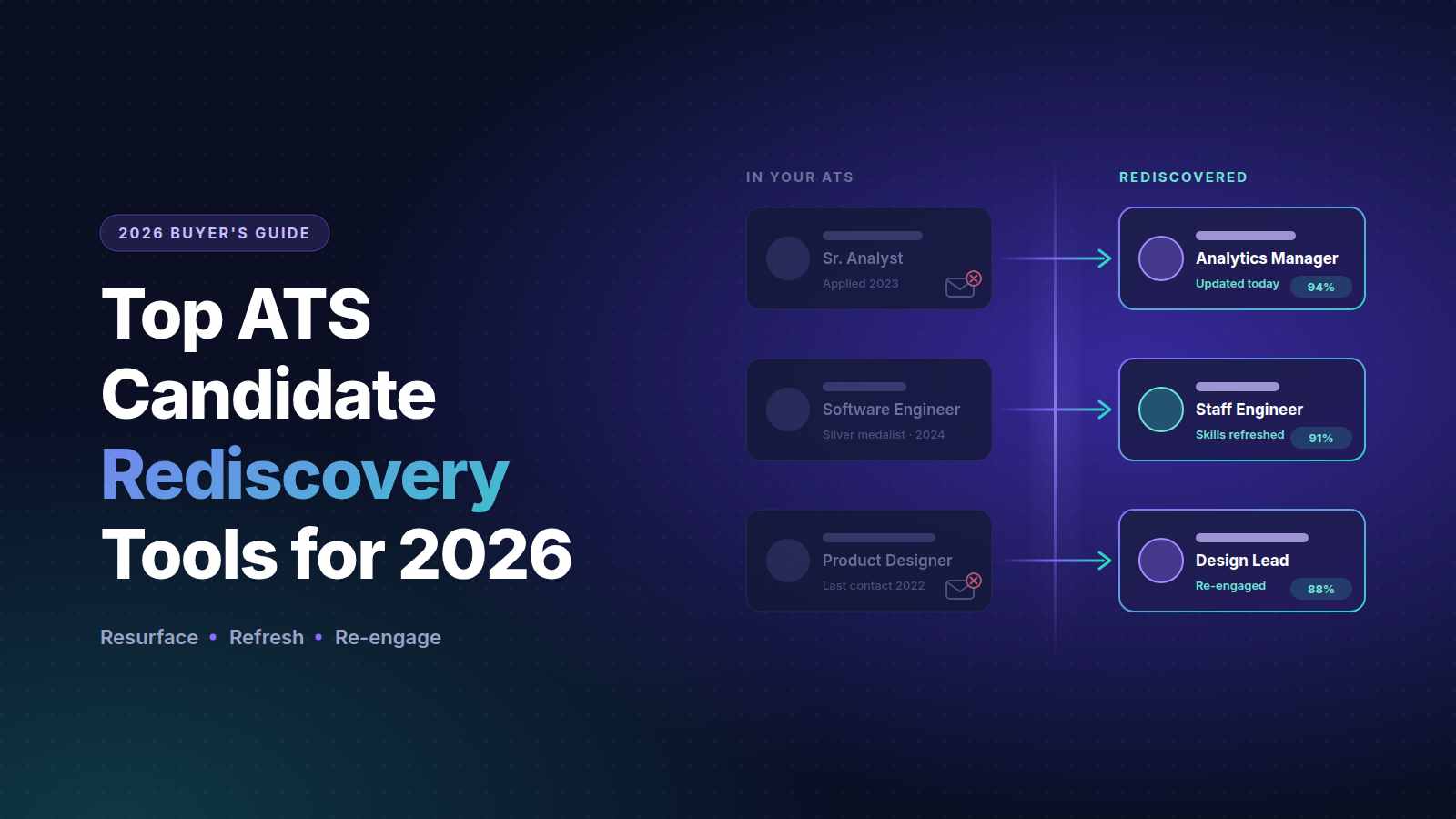
The catch is that an ATS is a system of record, not a system of action. It stores those candidates; it doesn't refresh them, rank them for today's req, or reach back out. That's the job of a rediscovery layer — and the tools differ sharply in how much of that job they actually do.
How we evaluated these tools
Five criteria separate a real rediscovery engine from a search box over stale data:
- Match quality. Does it re-rank your database against a live req by skills and fit — or just keyword-match old records?
- Data freshness. Does it continuously enrich profiles so titles, skills, and contact details are current? This is the make-or-break: rediscovery is only as good as the data it resurfaces.
- Re-engagement in one workflow. Can it find and contact and nurture the candidate in the same place — or does it just hand you a list to work manually?
- Provability. Can it report the share of roles you filled from your existing database, so you can show the savings?
- Architecture. Does it sit on top of the ATS you already run, or require you to migrate to its own system of record?
The top candidate rediscovery tools for 2026
1. hireEZ — rediscovery with continuous enrichment
hireEZ turns your dormant ATS into a live talent pool. It resurfaces 2.5x more candidates from records you already own, and — the part most tools skip — continuously enriches those records against a foundation of 1B+ open-web profiles, so a candidate's current title, skills, and contact details are refreshed rather than frozen at the date they applied. AI Review then re-ranks the pool against the live req (70% faster profile review), and because it's the same platform, recruiters re-engage the best matches with automated outreach without exporting a list anywhere. It sits on top of your ATS, integrating with 40+ of them — no migration — and reports how much of your hiring came from existing talent, which is the number that proves the savings.
Best for: Corporate TA teams that want to fill 20–30% of roles from their own database with data that's actually current — and keep the ATS they already run.
2. Eightfold — skills-based match intelligence
For rediscovery framed as a skills-matching problem, Eightfold is strong: its deep-learning models re-rank an existing database on inferred skills and potential, and the same engine powers internal mobility. If your priority is surfacing non-obvious internal and past candidates by capability, it earns a look.
The trade-off is scope. Eightfold is an intelligence layer — powerful at surfacing, lighter on re-engaging candidates as one continuous workflow — and it's a heavier enterprise deployment. Teams often pair the intelligence with a separate system to do the outreach.
Best for: Enterprises with a mature skills strategy that want matching depth and internal mobility alongside rediscovery.
3. Workday (HiredScore) — rediscovery inside the Workday suite
HiredScore was an early mover in AI talent rediscovery, surfacing and ranking candidates from an existing database. If you're already standardized on Workday, it's the path of least resistance.
Two facts shape the fit. Workday announced its acquisition of HiredScore in February 2024, and HiredScore is now one of three assembled products in Workday's talent-acquisition suite (HiredScore, Paradox, and Workday Recruiting). And it lands best inside the Workday ecosystem, not on top of whatever ATS you run. So the rediscovery is real, but it comes bundled with an ecosystem commitment.
Best for: Workday shops that want rediscovery inside their existing HCM and can absorb the suite's integration timeline.
4. Gem — CRM-first rediscovery
Gem resurfaces past candidates and silver medalists through its recruiting CRM, and re-engagement is a genuine strength — nurture campaigns and sequencing are core to the product.
The question at scale is freshness. Gem rediscovers against the data in its CRM; it doesn't run the kind of continuous open-web enrichment that keeps dormant records current, so surfaced profiles can carry the same staleness as the ATS they came from. Gem began as a CRM layer on top of an existing ATS and now also offers its own ATS, so a rediscovery project can run on either.
Best for: Mid-to-large teams that want CRM-driven re-engagement, whether on top of their current ATS or consolidated on Gem's suite.
The comparison
|
hireEZ |
Eightfold |
Workday (HiredScore) |
Gem |
| How it rediscovers |
Resurfaces + AI-re-ranks your ATS by fit for the live req |
Deep-learning skills/potential matching across your database |
AI discovery + ranking from the existing database |
CRM-based resurfacing of past candidates and silver medalists |
| Refreshes stale data? |
Yes — continuous enrichment against 1B+ open-web profiles |
Enriches within its model; less open-web refresh |
Within the Workday data model |
As fresh as the CRM record — no continuous open-web enrichment |
| Re-engages in the same workflow? |
Yes — outreach and nurture built in |
Lighter — surfaces, then hand-off to act |
Via the broader Workday suite |
Yes — nurture and sequencing are core |
| Keeps your ATS? |
Yes — integrates with 40+, no migration |
Usually a heavier enterprise deployment |
Best inside Workday |
Works on top of your ATS; Gem's own ATS is optional |
| Proves the ROI? |
Reports % of roles filled from existing talent |
Matching and mobility analytics |
Suite analytics |
Pipeline and productivity analytics |
The pattern: most tools can find an old candidate. The differences that decide whether rediscovery actually produces hires are whether the data is refreshed before you reach out, whether you can re-engage without leaving the tool, and whether you had to replace your ATS to get there. Eightfold's genuine edge is matching depth; hireEZ's is keeping the resurfaced data current and acting on it in one place, on top of the ATS you already own.
How to choose
Skip the feature list and ask three questions about your own situation.
First, how stale is your database? If your ATS records are more than a year old — old titles, bounced emails — match quality matters less than enrichment, and you should weight a tool that refreshes data before it resurfaces it.
Second, do you need to act, or just see? If the goal is hires, not a report, prioritize a tool that re-engages candidates in the same workflow rather than handing you a list to work by hand.
Third, what's the cost of adoption? Rediscovery shouldn't require an ATS migration. A layer that sits on top of your current system of record gets you to value in weeks; a suite that wants to become your system of record is a much larger decision than a rediscovery project.
FAQ
What is candidate rediscovery?
Resurfacing candidates already in your ATS — past applicants, silver medalists, and previously sourced profiles — and re-engaging them for open roles, instead of sourcing net-new. Done well, it's the cheapest and fastest hire available, because you've already paid to find and screen these people.
Why do ATS candidates need to be "refreshed"?
Because a stored record freezes at the moment the candidate applied. Titles change, skills grow, and email addresses go dead. A rediscovery tool like hireEZ that continuously enriches those records against live open-web data resurfaces a current profile, not a stale one — which is the difference between a reply and a bounce.
What's the best candidate rediscovery tool for 2026?
It depends on the job. For skills-based matching, Eightfold is strong; for teams standardized on Workday, HiredScore is the native option. For continuous-enrichment rediscovery that keeps the data current, re-engages in one workflow, and sits on top of any ATS, hireEZ is the better fit.
Do these tools replace my ATS?
The best-architected ones don't. hireEZ integrates with 40+ ATS platforms and adds the rediscovery layer on top — no rip-and-replace. Some suites, by contrast, increasingly expect you to adopt their own ATS to get full value, which turns a rediscovery project into a system-of-record migration.