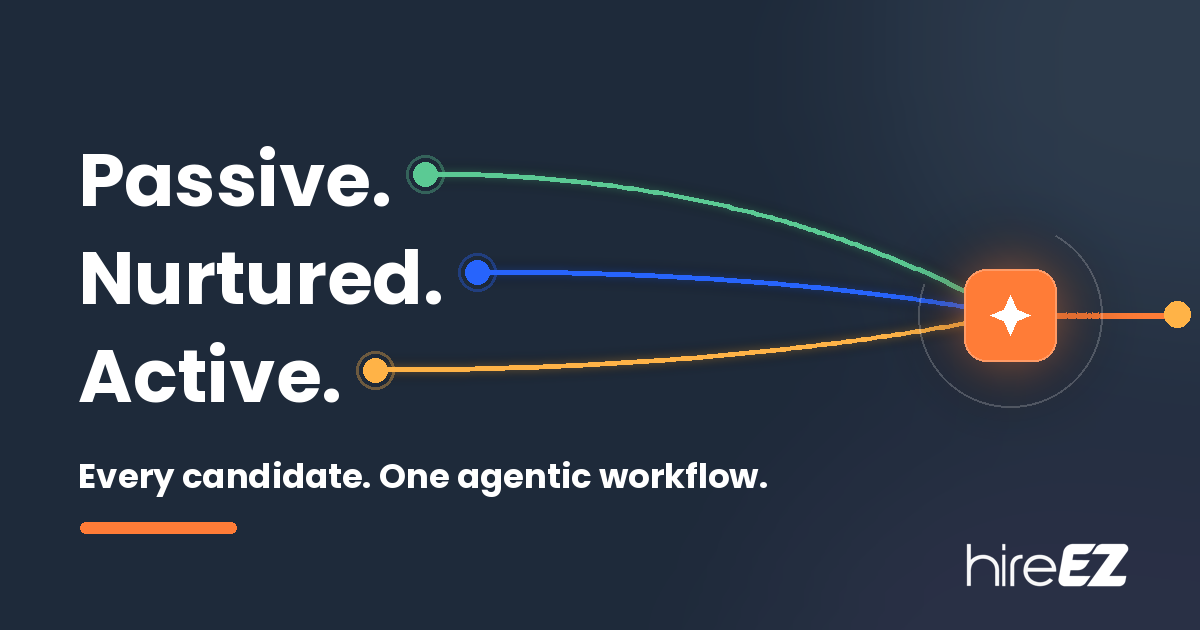
Agentic AI recruiting is AI that plans and executes recruiting work — not AI that suggests it. At the top of the funnel, an agentic platform takes a hiring manager intake, builds an ideal candidate persona, chooses the right mix of sourcing channels, and runs sourcing, outreach, and nurture until qualified, interested, and available candidates land in front of a recruiter. The recruiter reviews and approves the plan. The agent does the work.
That distinction matters because most of what gets called "AI recruiting" today is a chatbot or a matching score bolted onto one step of the process. Gartner reports that 82% of HR leaders planned to deploy some form of agentic AI inside their function by 2026. The question for TA leaders is no longer whether to use it — it's whether the AI they buy can orchestrate the whole top of funnel or just automate one slice of it.
What is agentic AI recruiting?
Agentic AI recruiting is a system that reasons across the full recruiting workflow and executes it: sourcing, screening, outreach, scheduling, and analytics. It sits on top of your ATS as an intelligent execution layer — a system of action working alongside your system of record.
The difference from earlier AI recruiting tools comes down to three capabilities. It plans (turns a job requisition and hiring manager context into a channel and outreach strategy), it acts (executes that strategy across platforms without a human triggering every step), and it learns (feeds results back into the next cycle).
A resume screener scores what shows up. An agentic platform decides where candidates should come from in the first place — and goes and gets them.
Why is the top of the recruiting funnel broken?
Because the two things that used to work — inbound applications and a single sourcing channel — both stopped working at the same time.
Inbound drowned first. AI-assisted apply tools have flooded pipelines with hundreds of applications per posting, most submitted in seconds. Industry funnel benchmarks now show only about 3% of applicants reaching an interview. Volume went up; signal went down.
Meanwhile, most enterprise teams still concentrate outbound sourcing on one expensive channel. That works for some white-collar talent pools. It fails completely for frontline, hourly, healthcare, industrial, and high-volume roles — the people who are not maintaining a profile on a professional network. If your sourcing strategy only sees one channel, you are invisible to most of the labor market you need.
TA leaders feel this as a math problem: more requisitions per recruiter, more channels to manage, and a C-suite asking why roles stay open. Each unfilled role has a revenue cost, and the funnel is where that cost starts.
How does agentic top-of-funnel orchestration actually work?
Here is the workflow EZ Agent runs, step by step.
01
AI intake with the hiring manager. The agent pulls the job description from your ATS and runs a structured intake conversation with the hiring manager to capture domain context and priorities — the things a JD never says out loud.
02
Ideal candidate persona. From the JD plus intake, the agent builds a best-fit profile: skills, experience shape, likely current employers, and what will make this person respond.
03
Channel strategy. This is the orchestration step most tools skip. The agent designs a top-of-funnel plan across fundamentally different talent supplies: open-web sourcing across 45+ platforms for passive talent, nurtured talent communities for warm, opted-in candidates, and active job seeker marketplaces for people ready to move now. It recommends the channel mix, ads budget, and outreach plan based on what the role actually needs.
04
Recruiter reviews and approves. No plan executes without a human decision. The recruiter sees the strategy, adjusts it, and approves it.
05
The agent executes. Sourcing, outreach, nurture, and pipeline management run continuously. What arrives at the recruiter's desk is not a pile of profiles — it's QIA candidates: qualified, interested, and available. Every outcome feeds back into the next plan.
One recruiter directing this workflow covers ground that used to take a team. That's the +45% recruiter productivity story — the same team, multiplied.
Which channels should an agentic top of funnel cover?
A single channel can't cover the labor market, because different talent moves through different doors. An orchestrated top of funnel needs at least three supplies working together.
1
Open-web passive talent
The largest pool: people not looking, findable across 45+ platforms and 1B+ candidate profiles. Right for scarce skills and roles where you must go get the person. This is also how teams cut LinkedIn spend — customers reduce LinkedIn Recruiter seats 50–60% while reaching 7x more qualified talent.
2
Nurtured talent communities
Candidates who have opted in and stay engaged over time. Warm supply converts faster than cold outreach. hireEZ's new partnership with Nexxt plugs a vetted, nurtured talent community directly into the agent's channel mix.
3
Active job seekers
For high-volume and frontline hiring, speed decides outcomes — frontline research consistently shows slow hiring is the top candidate frustration, and hourly candidates take the first credible offer. The Talroo partnership gives the agent direct access to high-quality active job seekers, the supply that matters most for blue-collar and high-volume roles.
The point is not any single channel. It's that one agent now plans and executes across all of them — with one strategy, one budget view, and one pipeline flowing into your ATS.
How is this different from point solutions and chatbots?
Every technology category follows the same arc. A system of record emerges. Point solutions pile on top of it. Then the point solutions collapse into a system of action. Sales lived it with Salesforce. Marketing lived it. Talent acquisition is next.
Your ATS is the system of record, and it isn't going anywhere. But the 5–10 tools stacked on top of it — one for sourcing, one for outreach, one for scheduling, one for analytics — each automate a fragment, and none of them talk to each other. A chatbot that screens applicants is a point solution. So is a matching engine, however good its scores are.
An agentic platform is the layer above that sprawl: it unifies talent data and executes the workflow end to end, with no ATS rip-and-replace and 40+ native integrations. Most customers replace 4–6 point solutions when they consolidate. That's a line item a CFO can see.
What Results Should TA Leaders Expect?
Hold agentic AI to numbers, not demos
50%
reduction in time-to-fill
60%+
reduction in hiring costs
+38%
candidate response rates
Benchmarks across hireEZ customers, including 70+ of the Fortune 500.
Deployment is measured in weeks, not quarters, because the platform layers onto your existing ATS. The standard we tell buyers to hold us to: prove value in 90 days.
The deeper shift is what this does to TA's standing in the business. When one platform runs your top of funnel, recruiting analytics can finally show the C-suite pipeline coverage, channel ROI, and the revenue protected by filling roles faster. Recruiting stops reporting activity and starts reporting outcomes.
How do you evaluate an agentic AI recruiting platform?
Four questions separate real orchestration from a point solution wearing the label.
Does it plan the channel strategy, or just execute searches? Ask the vendor to show the step where the AI recommends channel mix and budget for a specific role. If the demo starts at "here are matching profiles," it's a matching engine.
How many talent supplies can it reach? Count the doors: open-web passive talent, nurtured communities, active job seeker marketplaces. A platform limited to one supply can't orchestrate anything — it can only work its corner.
Where does the human sit? The right answer is in command of strategy: the recruiter approves the plan before execution and owns every candidate decision. Full autonomy with no review step is a compliance risk; a tool that needs a click for every task isn't agentic.
What happens to your ATS? The platform should read from it, write back to it, and enrich it continuously — never ask you to replace it. Anything that fragments your system of record is adding to the sprawl it claims to solve.
Does agentic AI replace recruiters?
No — and a top of funnel with no human judgment in it is a liability, not an efficiency. In the EZ Agent workflow, the recruiter approves the strategy before anything executes and owns every candidate decision. The agent removes the mechanical work between decisions: the searching, the sequencing, the scheduling, the follow-ups.
That human-in-command design is also where regulation is headed, with AI hiring laws increasingly requiring transparency and human oversight. Agentic AI done right gives recruiters more control over the funnel, not less — they direct strategy instead of drowning in execution.
Frequently asked questions
What does "agentic" mean in agentic AI recruiting?
It means the AI is an agent: it plans multi-step work, executes it across systems, and adapts from results — instead of waiting for a human to trigger each task. In recruiting, that's the difference between a tool that scores resumes and a system that builds and runs your sourcing strategy.
Does agentic AI recruiting replace the ATS?
No. The ATS remains the system of record. Agentic AI is the system of action that operates on top of it — hireEZ connects through 40+ native integrations with no rip-and-replace.
Does it work for high-volume and hourly hiring?
Yes — that's where orchestration pays off most. High-volume hiring is won on reach and speed, and an agentic top of funnel combines active job seeker channels (via Talroo), nurtured communities (via Nexxt), and open-web sourcing in one executed plan.
How fast can an enterprise team deploy it?
Weeks, not quarters — because it layers onto your existing ATS rather than replacing it. The benchmark to hold any vendor to: measurable value in 90 days.
Sources
Gartner, Top Future of Work Trends for CHROs, via Korn Ferry Talent Acquisition Trends 2026 · CareerPlug Recruiting Metrics Report (applicant-to-interview benchmarks) · Fountain Frontline Worker Report, via Gem: High-Volume Hiring · EU AI Act and NYC Local Law 144 (AEDT) · hireEZ results: internal customer benchmarks.