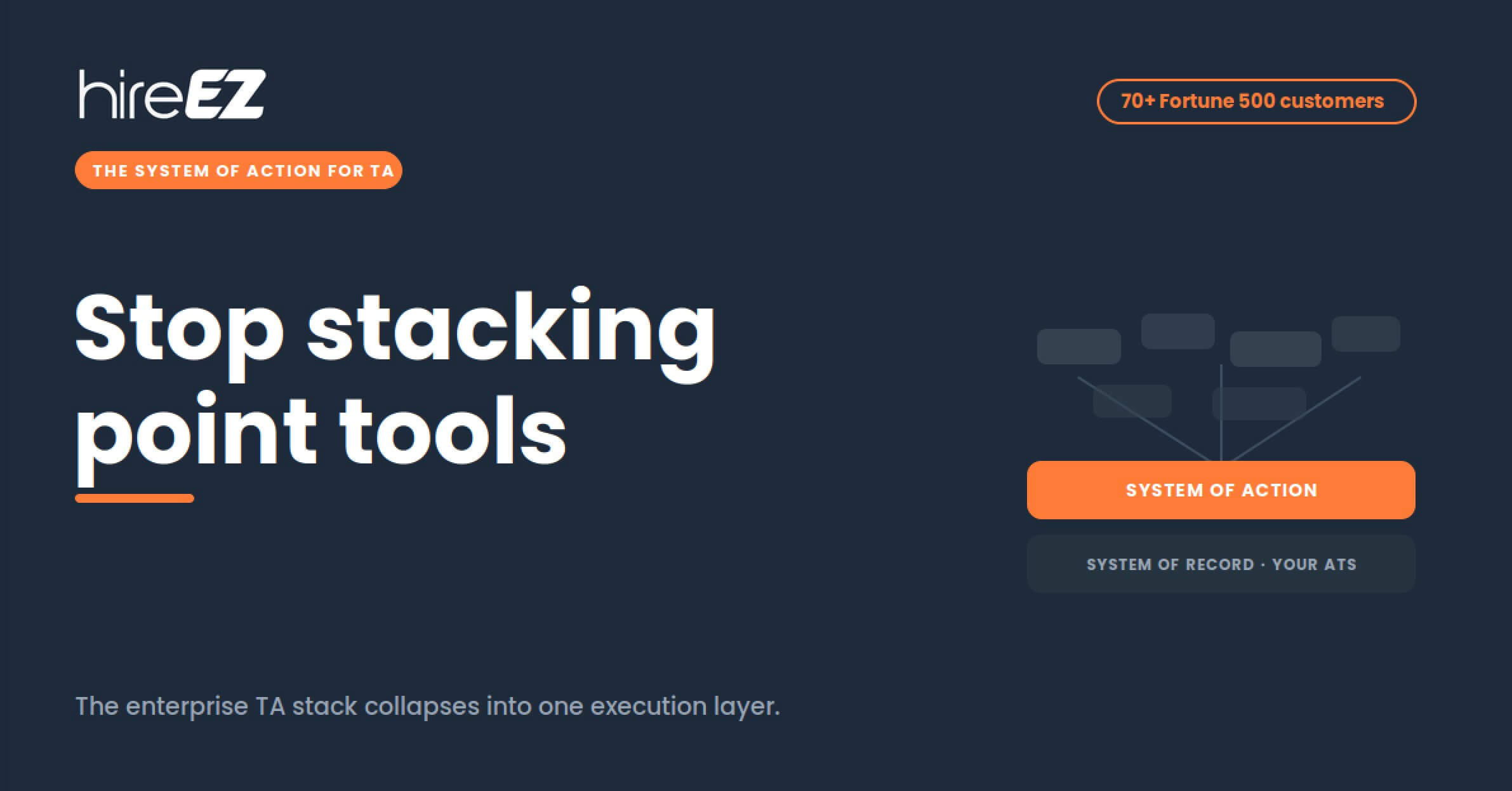
You don't have to accept that thesis to use this guide. But it explains why "which point tool is best" may be the wrong frame for a large team already running several of them.
Most enterprise tools fall into one of four buckets. Knowing the bucket tells you more than any feature list.
01 · Sourcing
Talent intelligence and AI sourcing
Strongest at the top of the funnel: finding and surfacing candidates across large public-profile datasets, with automated first-touch outreach.
Great at: discovery and reach for hard-to-fill or technical roles. Trade-off: the AI concentrates at discovery. Your team still runs sequences, replies, scheduling, and reporting, and it lives beside your ATS, not inside your workflow.
Representative vendors: SeekOut, Findem, Eightfold, Juicebox
02 · Screening
AI screening and interview automation
Parse resumes, score candidates against criteria, run structured AI interviews or assessments, and act as AI notetakers on calls.
Great at: cutting first-round volume and standardizing evaluation. Trade-off: they solve one stage. If screening is your only break point that focus is a feature; if not, it's another silo to integrate and govern.
A crowded field of point tools and AI notetakers.
03 · ATS-native
ATS-native AI and HCM suites
Recruiting AI built inside the system of record. The pitch is data continuity: everything in one place.
Great at: governance, complex approvals, and suite-standardized orgs. Trade-off: implementations can run many months to a year-plus, the call is often made at the IT/CFO layer, and shipped features can trail the roadmap. Ask what's live today.
Representative vendors: Greenhouse, Workday, iCIMS, SmartRecruiters, Phenom, Beamery (and Bullhorn in staffing/RPO)
04 · Execution layer
Agentic execution layer (system of action)
The newest category. Instead of another tool beside your ATS, it sits on top of any ATS, unifies talent data, and automates the full workflow (sourcing, screening, outreach, scheduling, analytics) end to end.
Great at: consolidating the stack without rip-and-replace. Note: this is the category hireEZ defines for itself, so judge the section below against the criteria, not the branding.
The emerging layer. See "Where hireEZ fits."
How should an enterprise actually evaluate these platforms?
Run every shortlisted vendor through this checklist. It's ordered the way a CFO-ready evaluation should be.
- Where does your funnel actually break?Map your time-to-fill stage by stage. Buy for the stage that's bleeding, not the one that demos well.
- Does it integrate with your ATS, or replace it?Rip-and-replace of a system of record is the most expensive, highest-risk path in TA tech. Favor tools that layer on top of what you already run.
- Workflow coverage: one stage or end to end?A point solution fixes one break. An execution layer reduces the number of break points, and the number of vendors you manage.
- Stack consolidation and total cost.Count the tools a platform lets you retire, not just what it adds. Consolidating 4-6 point solutions is often a bigger line-item win than any single feature.
- Does it unlock the data you already own?Most enterprises sit on a large ATS database that never gets re-engaged. A platform that resurfaces and enriches it fills roles from talent you already paid to acquire.
- Can it quantify revenue impact?The criterion that survives a CFO review. Can the analytics translate unfilled roles into dollars at risk, not just report time-to-fill? Budgets are defended with revenue math now, not activity metrics.
- How deep is the "agentic" capability, really?Does the AI reason and execute across steps, or assist a human at one step and call that autonomy?
- Compliance, governance, and data provenance.A first-tier criterion now. Documented bias audits? Human oversight? Explainable rankings? Current SOC 2 Type 2? And where does the candidate data come from, with consent?
- Time to value.Weeks-to-deploy versus a year-long implementation is a material difference in cost and in how fast you prove ROI.
- Will recruiters actually use it?Adoption is where most enterprise tools quietly fail. The end users aren't the buyers, but they decide whether the investment pays off.
What does "agentic AI recruiting" actually mean?
Cut through the buzzword: agentic AI reasons across a workflow and takes action across multiple steps, rather than assisting a human at a single step.
A keyword search that returns a list is not agentic. A chatbot that drafts an outreach email is not agentic. An agent that sources against a role, prioritizes the existing ATS database, drafts and sends personalized outreach, books the interview, and updates the record (coordinating those steps) is moving toward agentic.
The honest test when a vendor says "agentic": ask what the system does on its own across the funnel, and ask for proof. If the answer is one automated step with a human doing the handoffs, it's automation with a new label.
The 2026 context every shortlist needs: AI hiring regulation
If you evaluate AI recruiting tools in 2026 without weighing regulation, your shortlist is incomplete. This is now a top-of-mind issue for CHROs, CFOs, and general counsel.
AI used in hiring is classified as "high-risk" under the EU AI Act (Regulation (EU) 2024/1689). Recruitment, candidate evaluation, and targeted job advertising all trigger obligations: risk assessments, technical documentation, bias testing, human oversight, transparency disclosures, ongoing monitoring, and record-keeping.
The reach is extraterritorial, like GDPR: if your AI system is used within the EU or affects EU residents, it applies regardless of where your company is headquartered.
Up to 35M EUR / 7% of global turnover, prohibited practices
Up to 15M EUR / 3% deployer breaches, high-risk
Aug 2, 2026 headline high-risk date
On timing: the headline enforcement date for high-risk obligations has been August 2, 2026. A proposed "Digital Omnibus" package could defer some high-risk obligations as late as December 2027, but as of mid-2026 it was still moving through adoption and is conditional. Most legal counsel advise treating the original timeline as binding rather than betting on a delay.
In the U.S., New York City's Local Law 144 already requires bias audits for automated employment decision tools, with per-violation fines. More state and local rules are following.
The practical takeaway: under these regimes the deployer (that's you) carries compliance responsibility, even when a vendor implies otherwise. Favor platforms that conduct documented bias audits, build in human oversight, can explain decisions, hold current SOC 2 Type 2 certification, and can show clean, consented data provenance. "Trust us" is not a compliance posture.
So which platform is best for your enterprise?
Match the category to the break point:
Top-of-funnel discovery is the gap (can't find enough qualified or niche talent)
→
Talent intelligence / AI sourcing
First-round volume is the gap (recruiters drowning in screening)
→
AI screening / interview automation
Standardized on one HCM suite, IT/CFO already aligned
→
ATS-native AI
Running 5-10 tools on top of your ATS and the cost/integration sprawl is the real problem
→
Agentic execution layer
For many enterprises at 1,000+ employees, the strategic recommendation is to stop buying point tools one bottleneck at a time. Each one adds integration debt, another contract, another governance surface, and another login your recruiters ignore. The durable architecture is one execution layer on top of the ATS you keep.
That's a point of view, and here's the honest counter-case. If you have exactly one break point, a best-in-class point tool can be the faster, cheaper fix. And if your organization has already committed to a single HCM suite at the executive level, fighting that with a third-party layer may not be worth the friction. Buy the architecture that fits your reality.